
Wang Qingsong: “It is more important if my artworks become social illustrations instead of entering art museums.” – Deng Yu, Nanfang People’s Weekly 2020
2020WANG Qingsong
“It is more important if my artworks become social illustrations
Instead of entering art museums.” by Deng Yu, Nanfang People’s Weekly
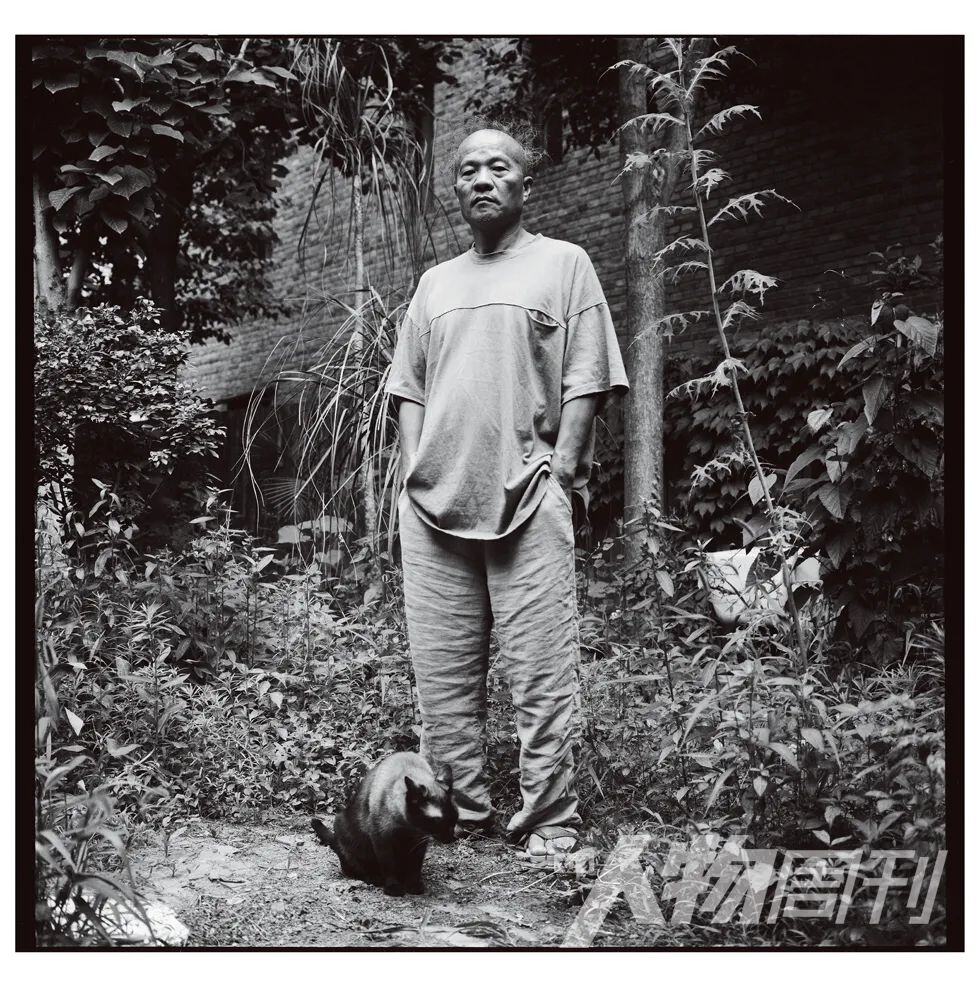
image courtesy of Jiang Xiaoming
“At a certain time, if you are better than some Western photographers, they will not believe in you, and some might stop you. Think about it! We might have learned the surface when we first studied the West. Probably we misunderstood and misread the West. After a long time, we realize that these learnings collide with our own foundation. Nowadays, this young generation go overseas much early and learn the best of the West. But I’m afraid they will be at a loss after learning. So, what is the next step?”
As if on the bare ground, many thin columns that were not straight stick out crookedly from a chimney. It is hard to distinguish where the chimney pillars are, and where the smoke comes out. But there is this three-dimensional effect. Looking closer, one sees a pile of sparse weed, each of which tilts towards the sky, but never droops.
Walking closer to the 8.3 meter tall by 6.4 meter blue background of a “big headed photo” on the gallery wall at Tang Contemporary, one bursts out, “Wow, it’s really hair.”
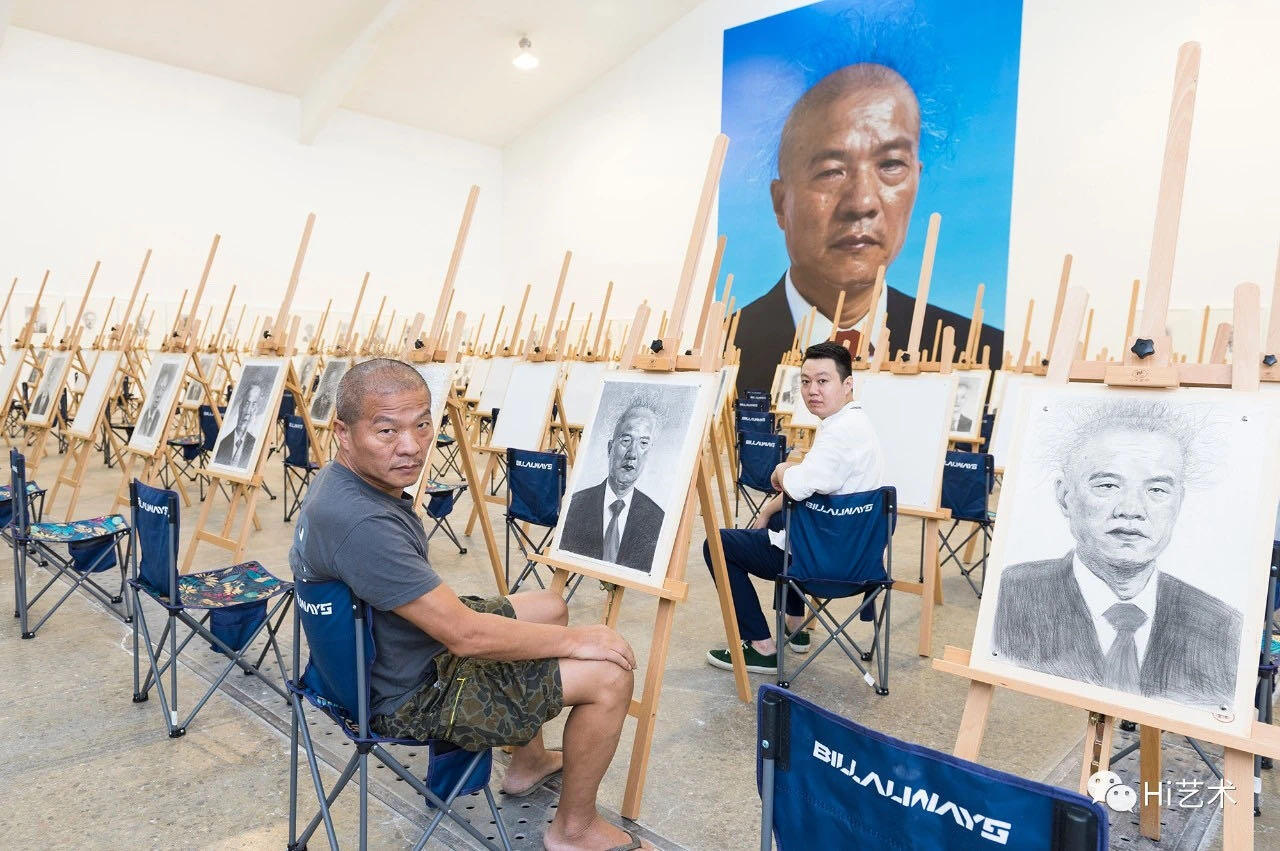
Wang Qingsong and Cui Cancan
The face of the man in the photo is swarthy and shiny, as if he is a fitness contestant with concentrated tung oil on his face. The bloodshot eyes are shedding sad condensed tears. Oversize, solemnity in dark suits, white shirts and red ties are swept away by the grotesque hairstyle, bringing laughter to everyone whoever sees it. Looking at the picture again, every “future art candidate” has to draw such an interesting person. The sketches collected on site and in the original works are really surprising and humorous. The tongue-in-cheek banter directed by the artist was tacitly “colluded” by painters and viewers whom the artist had no intention of choosing.
This work originally wanted to invite 500 students (models) for participation. Due to 2020 Coronavirus, he had to forgo this idea and photoshoot only empty chairs in the outdoors.
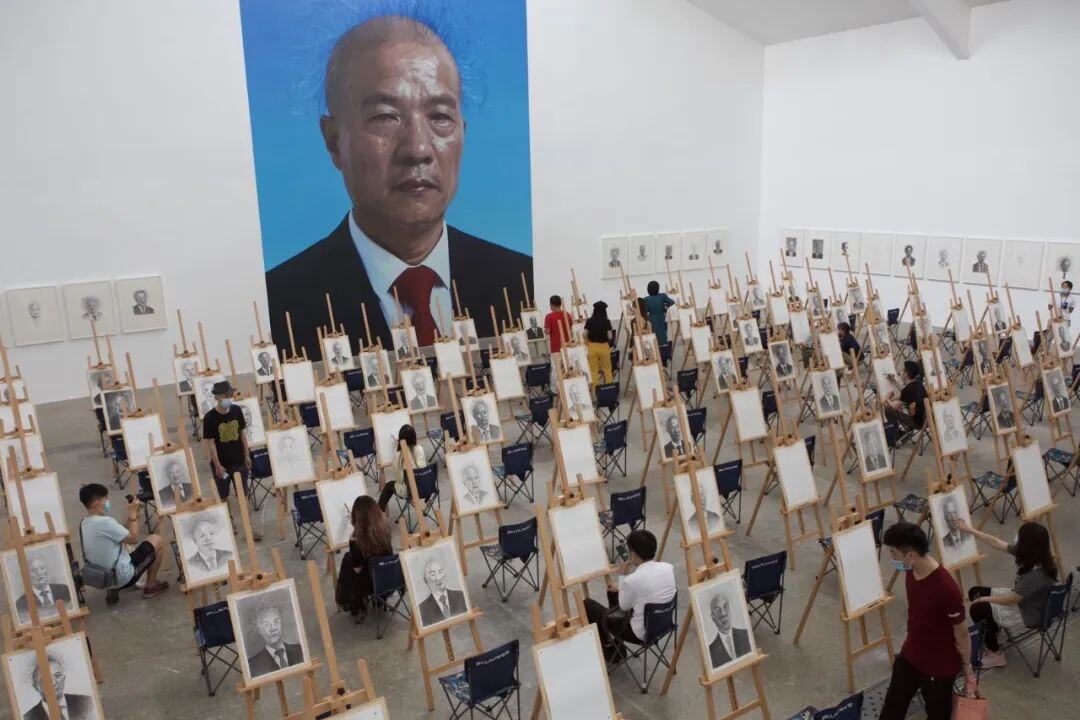
During installation, this scene of art examination is “moved” to the gallery. The ID photo that every student sketched was enlarged on the wall. The final photo work is placed on the opposite wall. Viewers are invited to try out sketching on the easels.
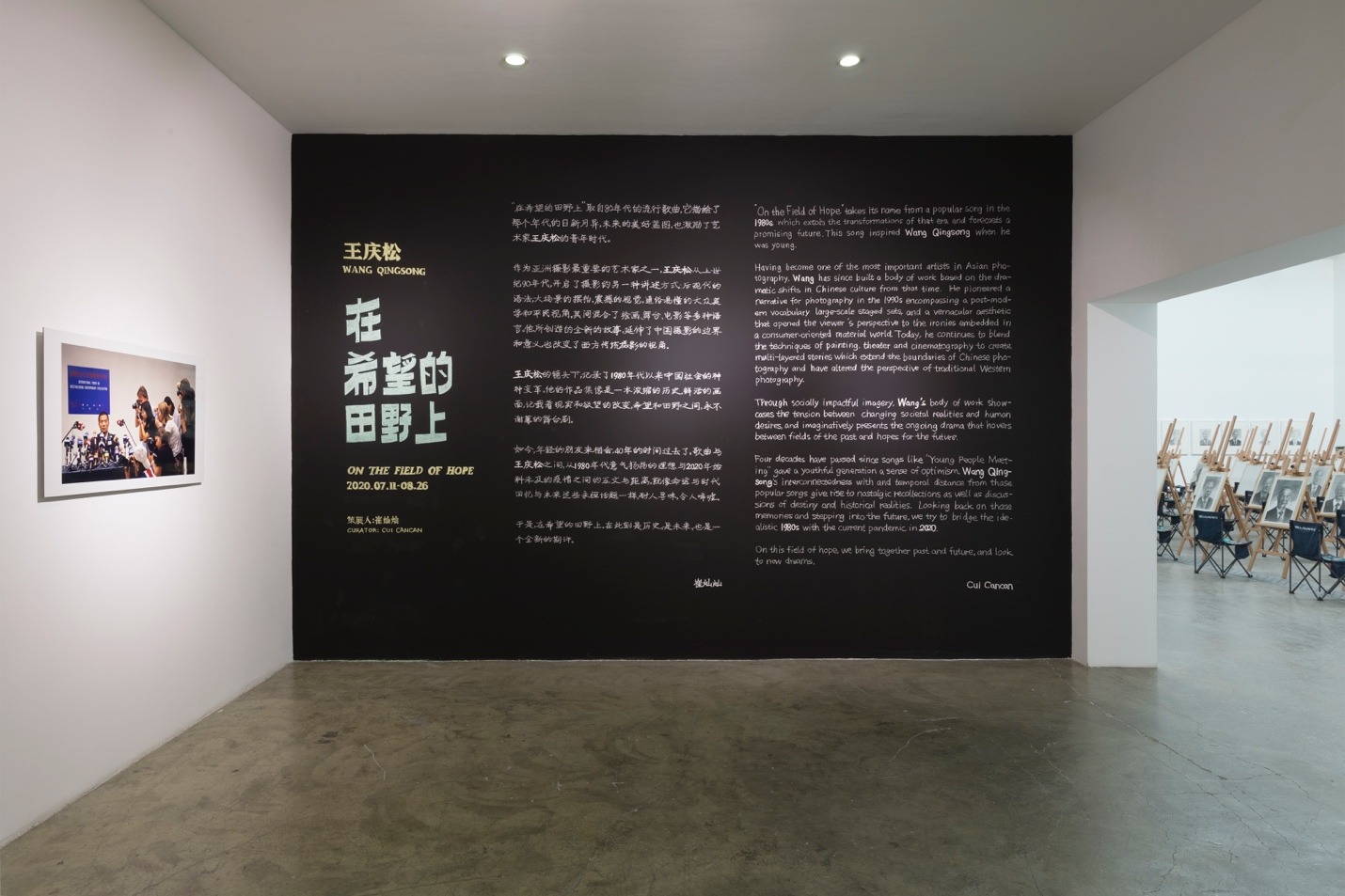
It is obvious that the superficial intention of the work “On the Field of Hope” directs towards art academy tests and unified art education model. But this is only one of the many loaded expressions. Everything else is silent, illegible and unspeakable.
Wang Qingsong, with his typical “Chimney Hair”, is recognized in the art circle as a pioneer in Chinese conceptual photography although he does not accept this label at all. Over the past 20 years, he has been noted for constructing large scenes, using large format camera, creating high definition images, inviting models to stage dramatic narratives that relate to “like fake but real” scenarios as his identifiable markers.
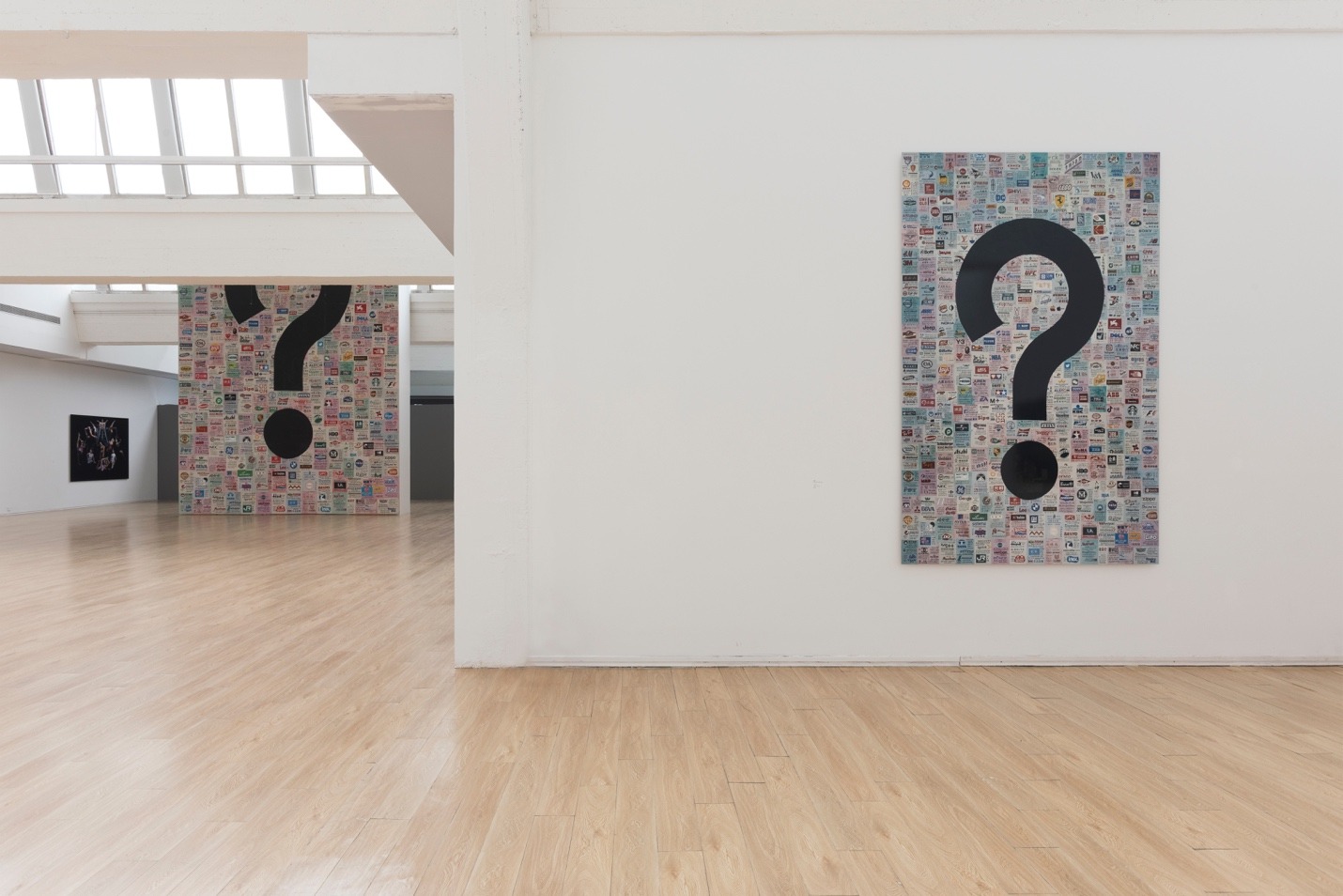
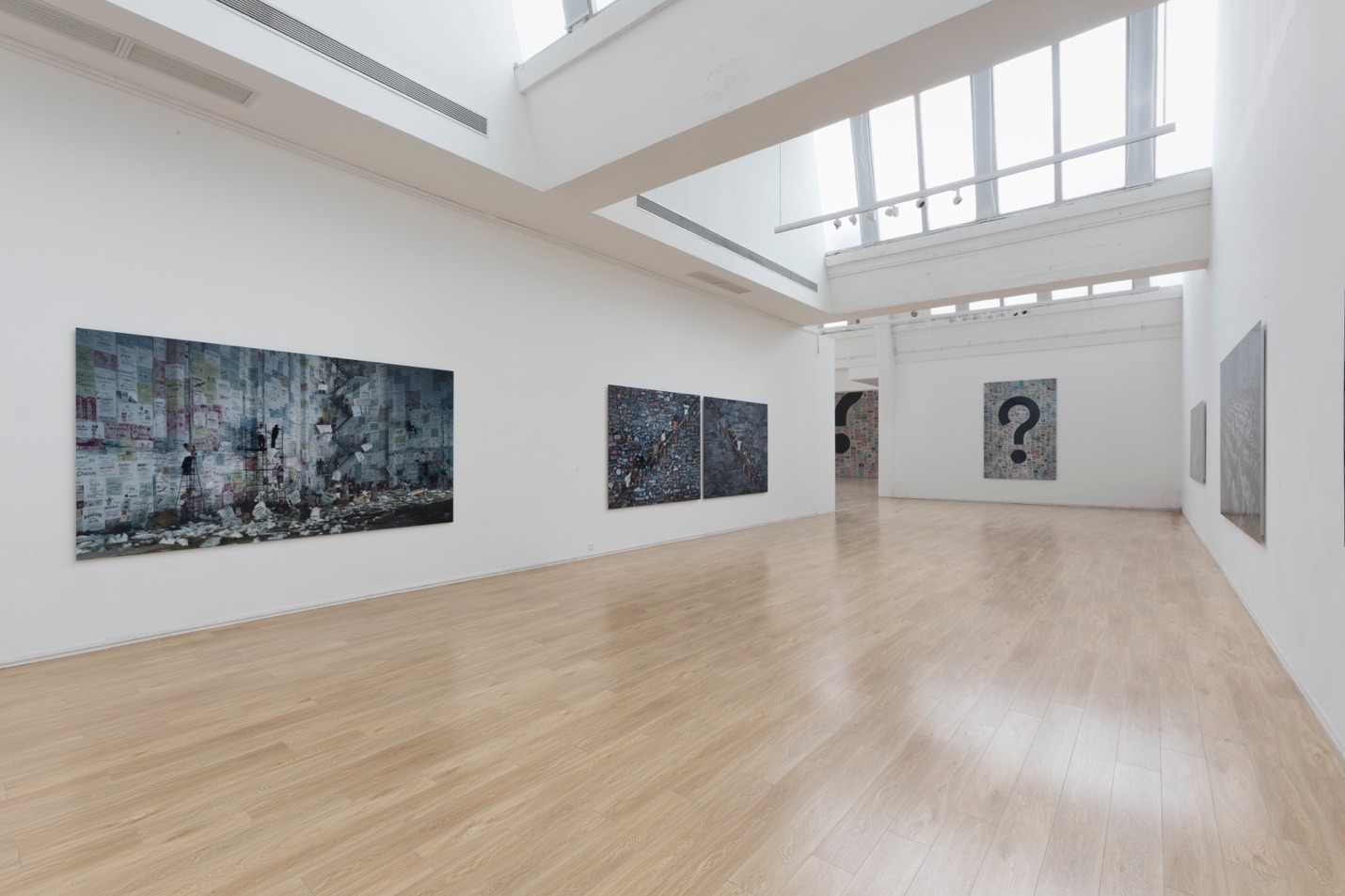
His photos are well-presented in exhibition halls. The models wearing “unpopular” costumes and weird makeup, for example, in “Night Revels of Lao Li” (2000) unfold an unclear story through unrolling a scroll of five-frame movie still. In “Follow Me” (2003) and “Question a Brick Wall” (2020), he condenses massive amounts of information from different times and spaces into one single frame. Looking at his photos is like playing “scavenger hunt”. A familiar LOGO, a bundle of wigs or exposed dentures, a book in his hand, and small objects in a pile of rubble challenge viewer’s acute vision, picking out and guessing the artist’s pre-embedded “Threads”.
He often portrays himself as a peasant, worker, teacher, patient, scribbler, vagabond or an unidentified person, quietly hiding in his photos. Wang Qingsong plays the role of a “director”, an actor and a voyeur, all in one.
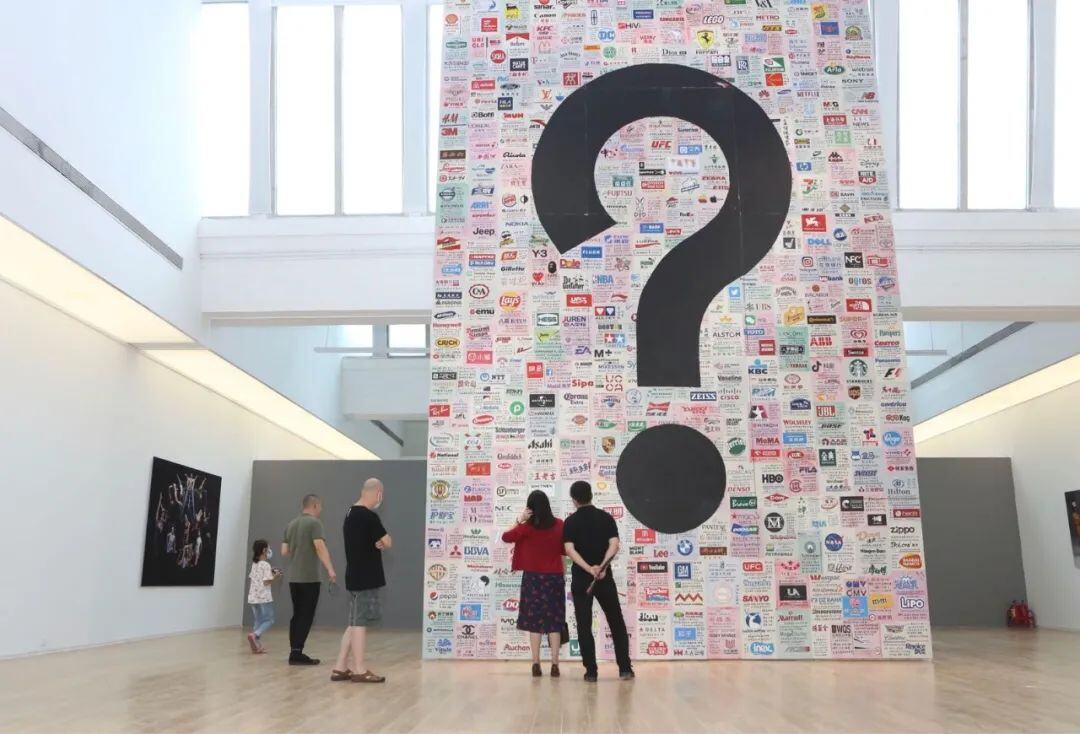
Those models, props, and Wang Qingsong himself in the photographs and outside the lens contribute together to completing his mission, with full heart and mind, to record the grotesque, absurd and painful epoch and eroded humanity. His greatest hope is that his work can become a social illustration (in newspapers and magazines) in the future —“This is more important to me than entering an art museum.”
Straightforward and gaudy
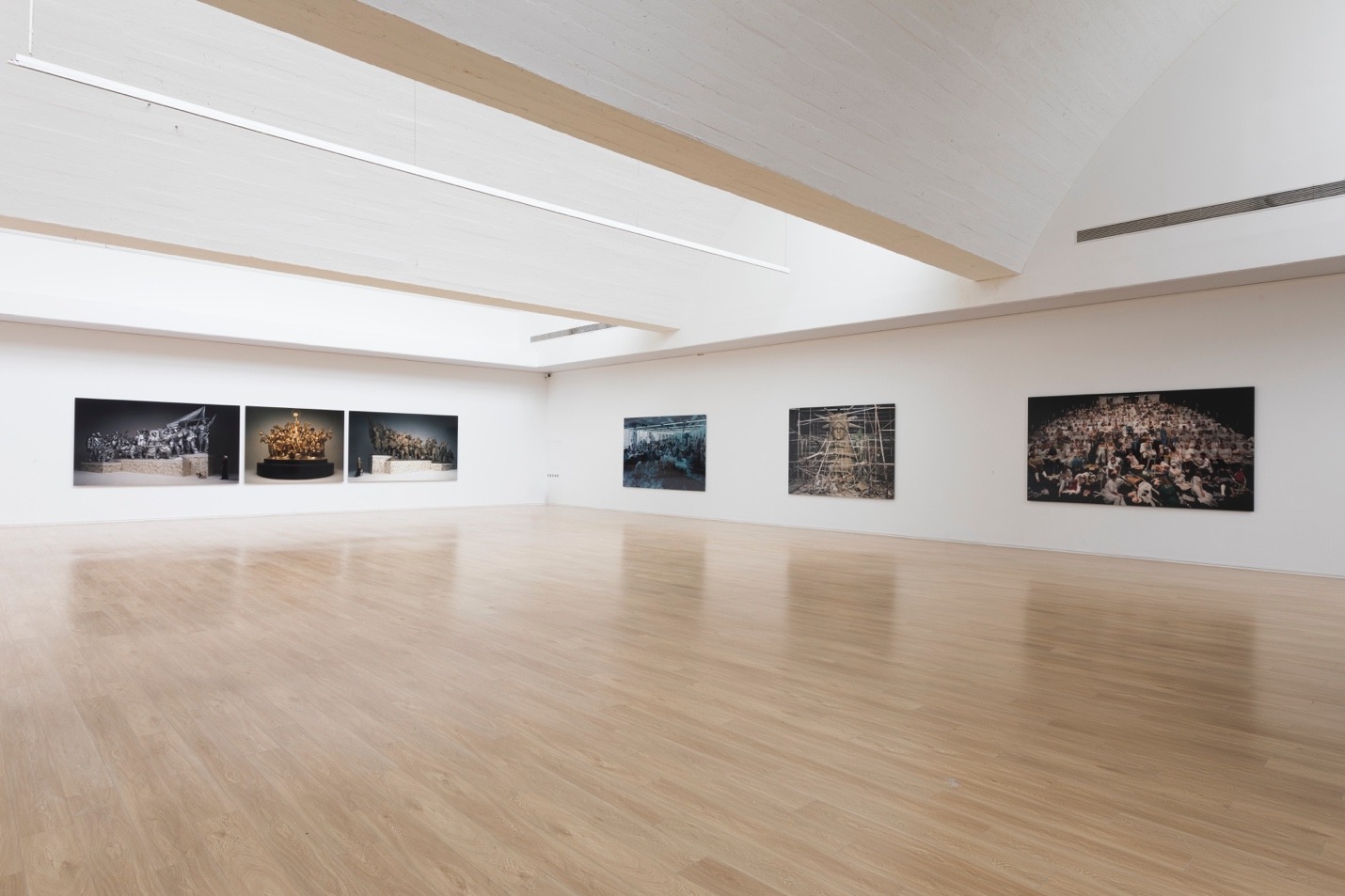
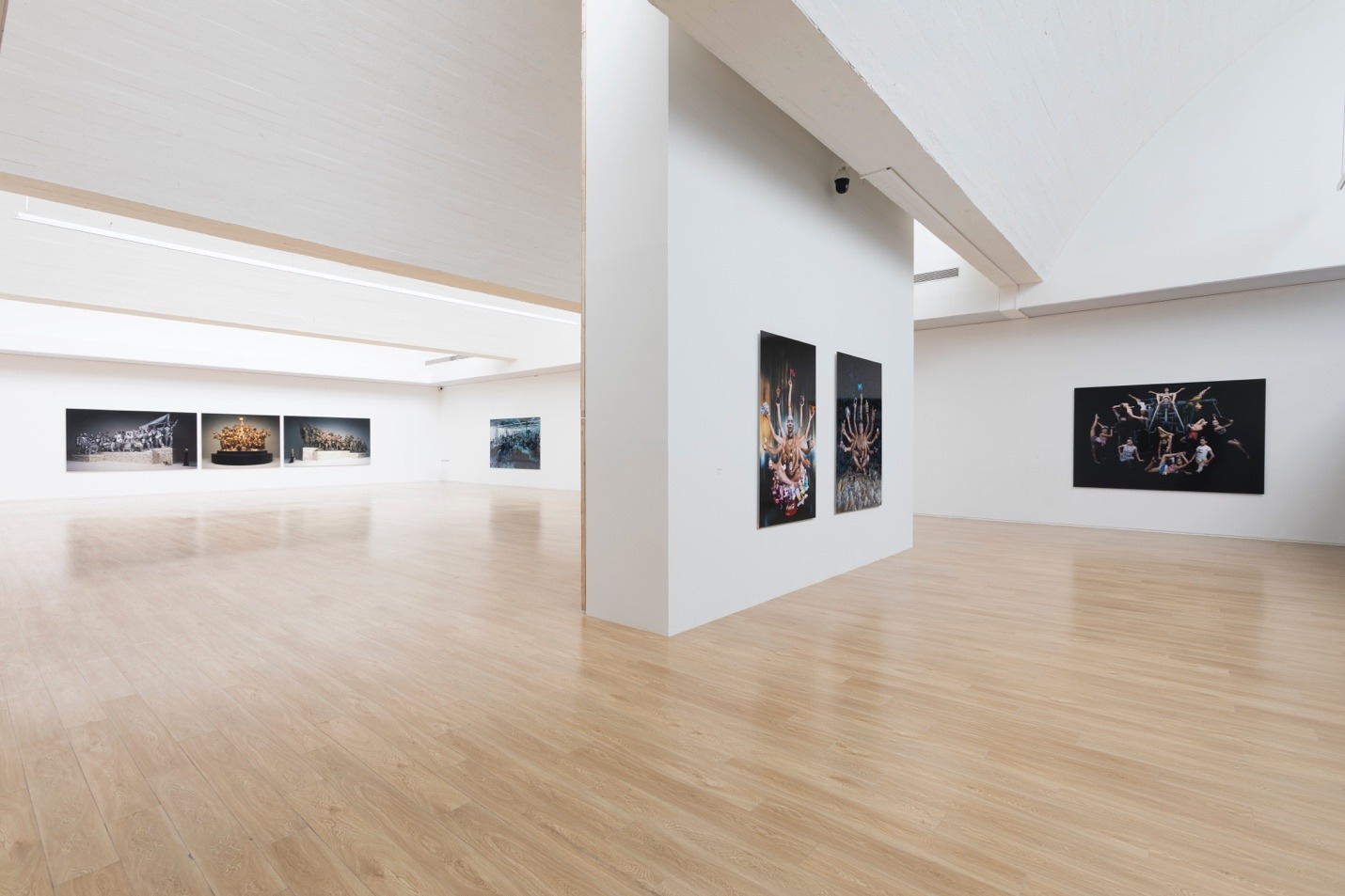
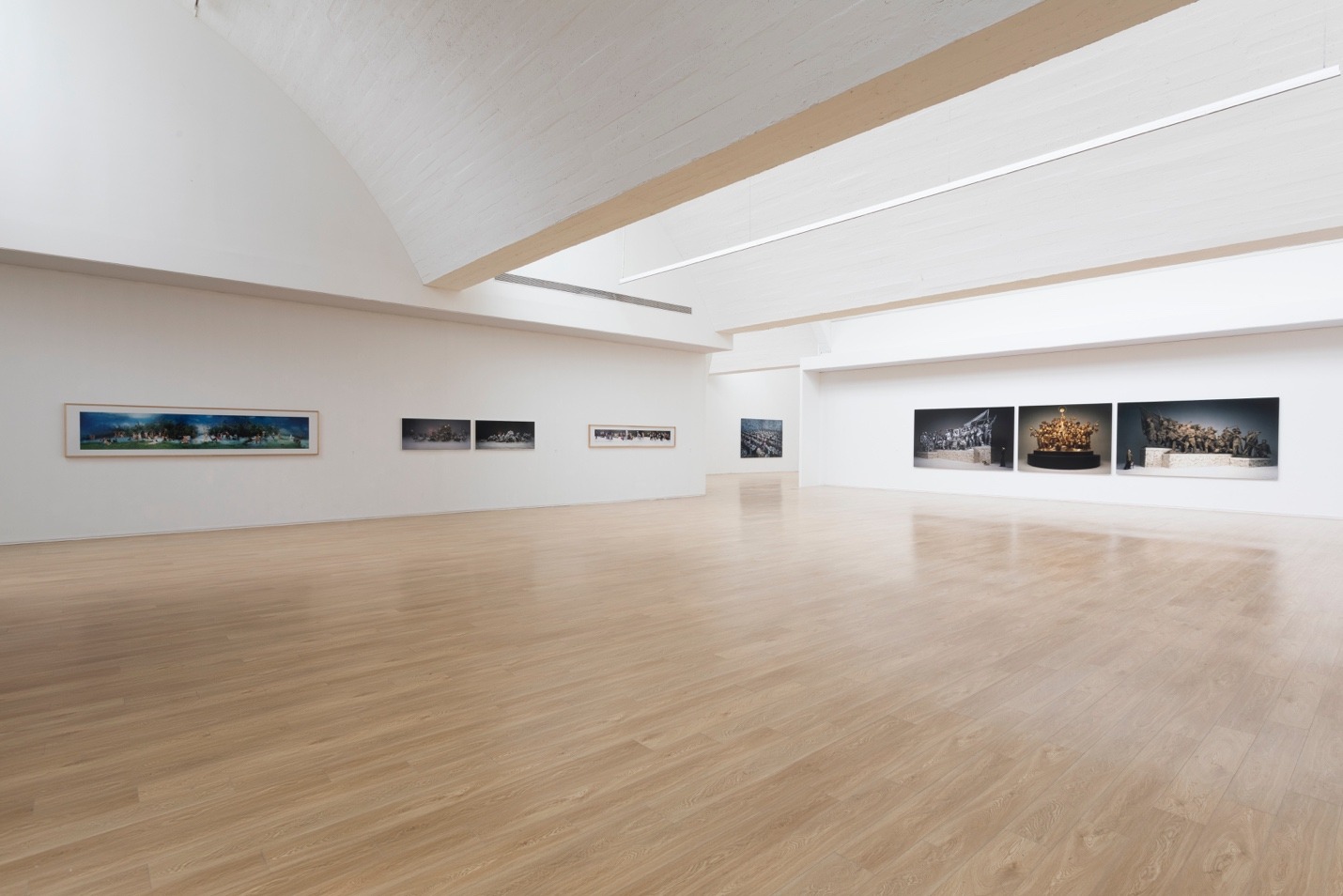
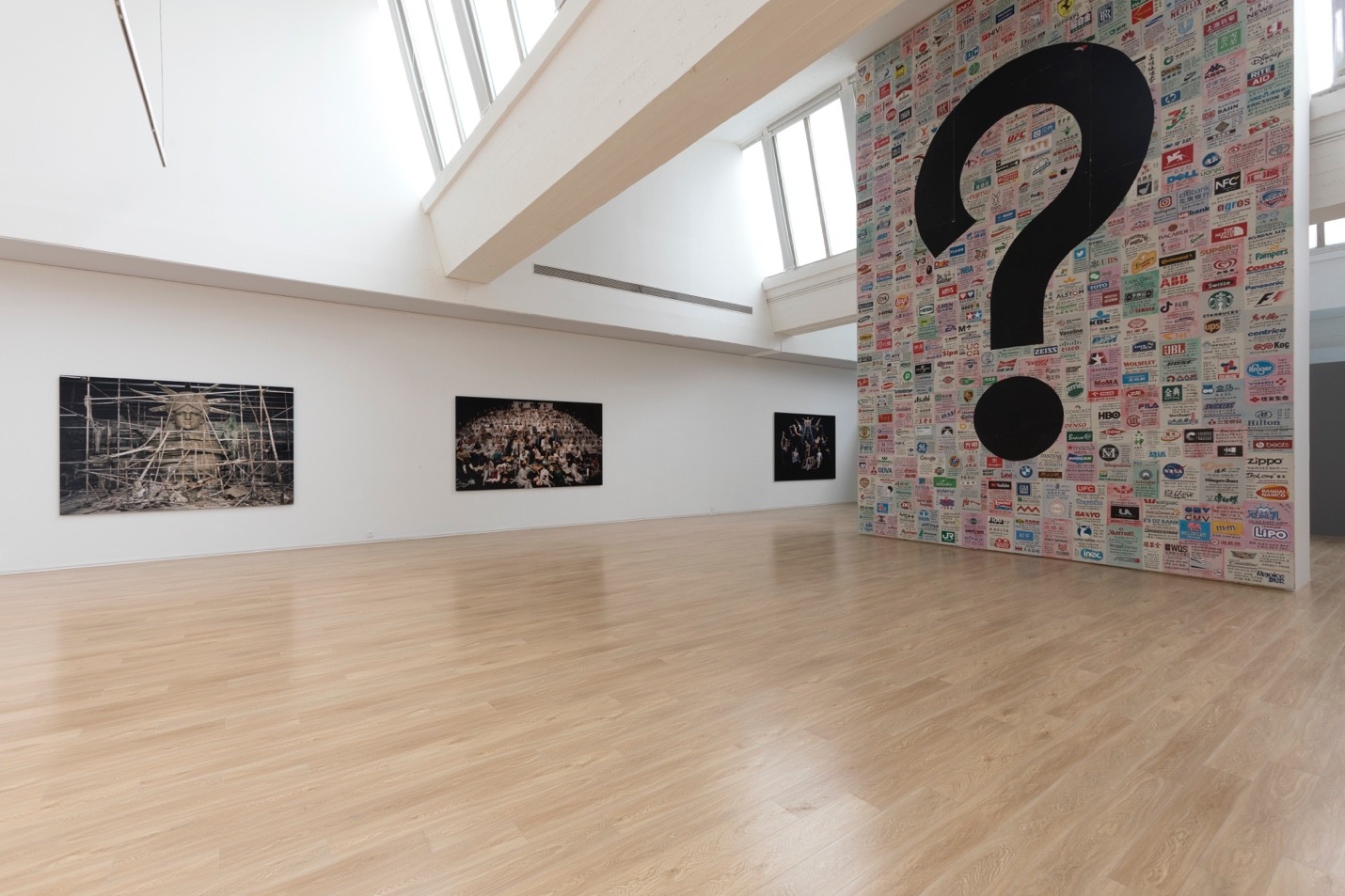
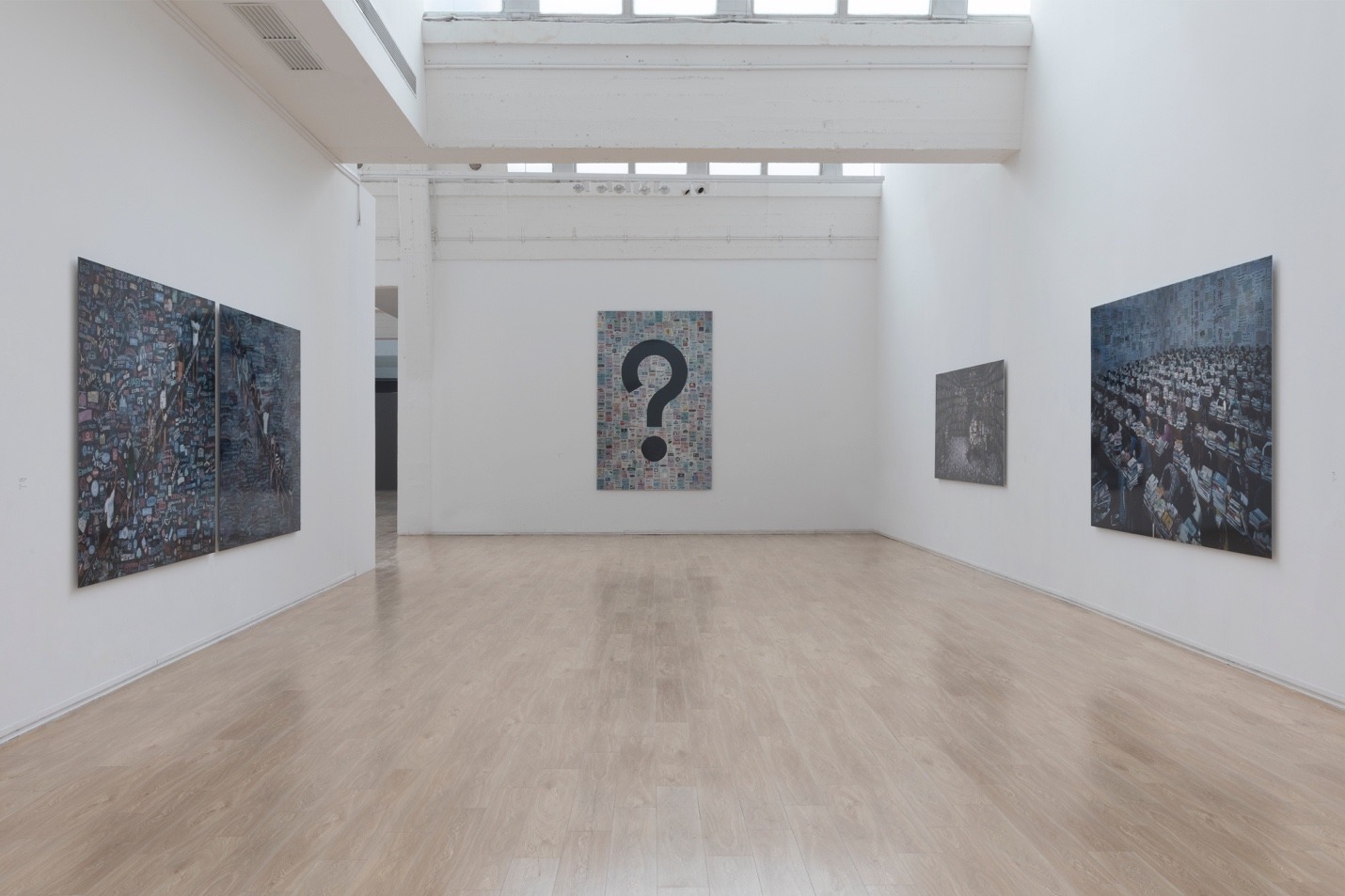
Entering Tang Contemporary (two gallery spaces), one finds coherence between the collection of sketches installed in the big open space and the contemporary photography scenario depicted in “Fotofest” (2005) at a smaller space. In the second gallery, the installation of multiple panels for shooting his latest work “Question a Brick Wall” (2020) stands like a monument in the center, reproduced from delineated symbols, logos and advertisements of commercial brands that represent the current lifestyle. Facing this work on the opposite wall is a triptych, “Past, Present, and Future”, which depicts the historical changes. The other two side walls hang “Night Revels of Lao Li” (2000), a fancy dinner party, “Temporary Ward” (2008), a blood-stained hospital ward. “New Women” (2000), an exaggerated fashionista, and “Happy Bodybuilders” (2013), a fetish trove for muscles, look at each other.
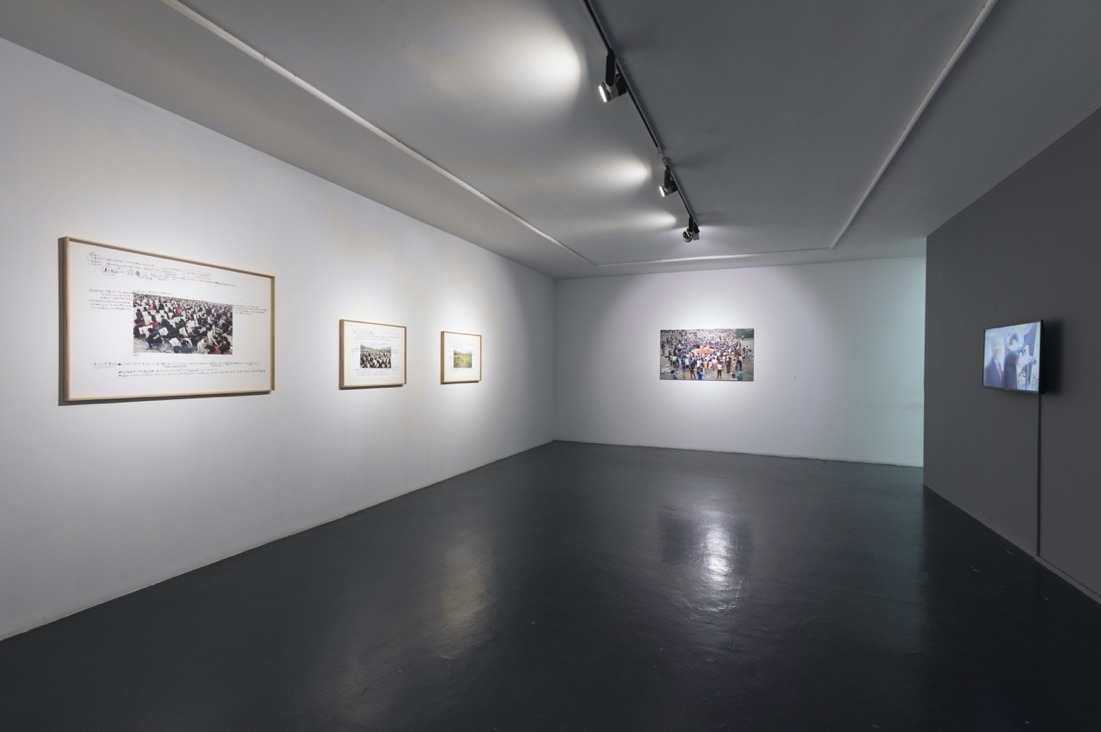
The curator Cui Cancan believes that Wang Qingsong’s photography never ceases at the functionality of recording facts only. He places doubts, criticisms and ironies into real but suspicious scenes. “He is photographing the idolized images of China. In fact, he stacks a variety of isolated moments infinitely into a history landscape.”
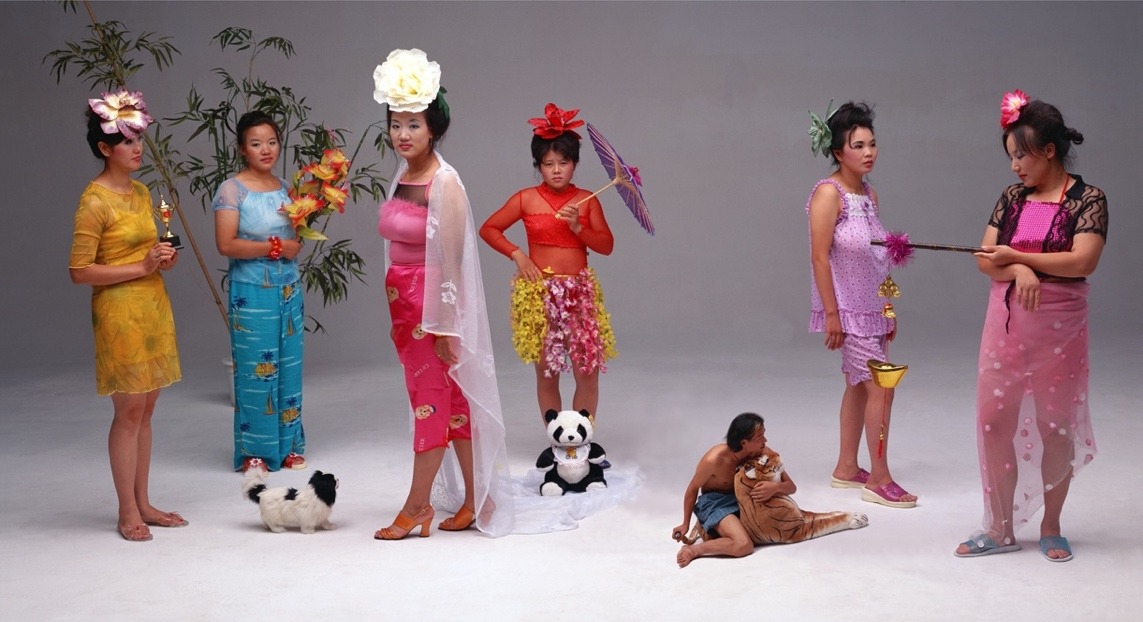
New Women, 120x220cm, 2000
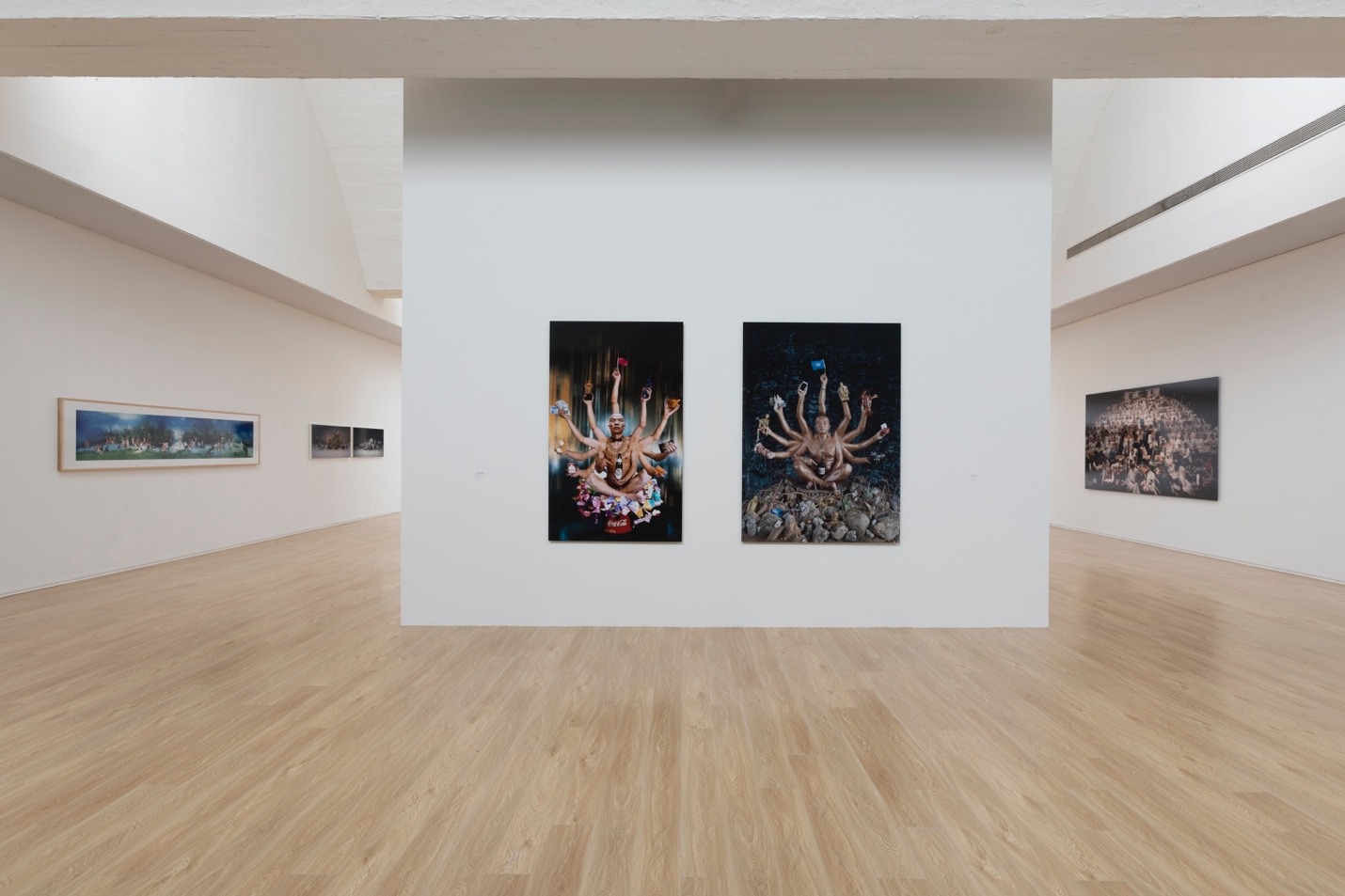
On the back of “Question a Brick Wall”, two juxtaposed photos of “Buddha with Thousand Hands” provokes the whispers of two students in the audience.
“Requesting Buddha Series No.1” was finished in 1999. The young “Buddha” sits on a Coca-Cola can decorated with flashy colored paper, and his hands reach out for US dollars, CDs, a big brother’s mobile telephone, gold ingots and a Kodak film, while his index finger points at a bottle of domestic beer. “Bequeathing Buddha”, finished 20 years later, see an “Old Buddha” holding a pork stick bone, a skeleton frame, a smart phone, and a digital camera. In the center of this image, the beer bottle was replaced with a wine bottle.
“From Yanjing Beer to Chateau Lafite Rothschild Wine, a qualitative leap!”
“Is this wine bottle real?” The two students open an online shopping platform and curiously search for authenticity, trying to figure out whether the bottle comes from a seller of bootlegged wine bottles.
In fact, the lobster and stick bones were all bought by his assistant at a market the day before the filming. “The biggest lobster is picked.” Chateau Lafite Rothschild Wine is also true, produced in the year when he was born. “My friend gave it to me as a gift when he learnt I need one for my shooting.”
The two students glance at the year the photo was taken, and asked each other, “1999, has China joined the WTO?” Then one said, “One photo is called “Requesting Buddha” and the other is called “Bequeathing Buddha”. I feel like that I know what he wants to say.”
Being too straightforward and vulgar is the first impression some viewers have for Wang Qingsong’s works. And he often says, “Don’t think too deeply! What you understand is what you see.” He never thinks that he was engaged in art. “I am more concerned about reality than artistic forms, because reality affects each of us even if we are indifferent.”
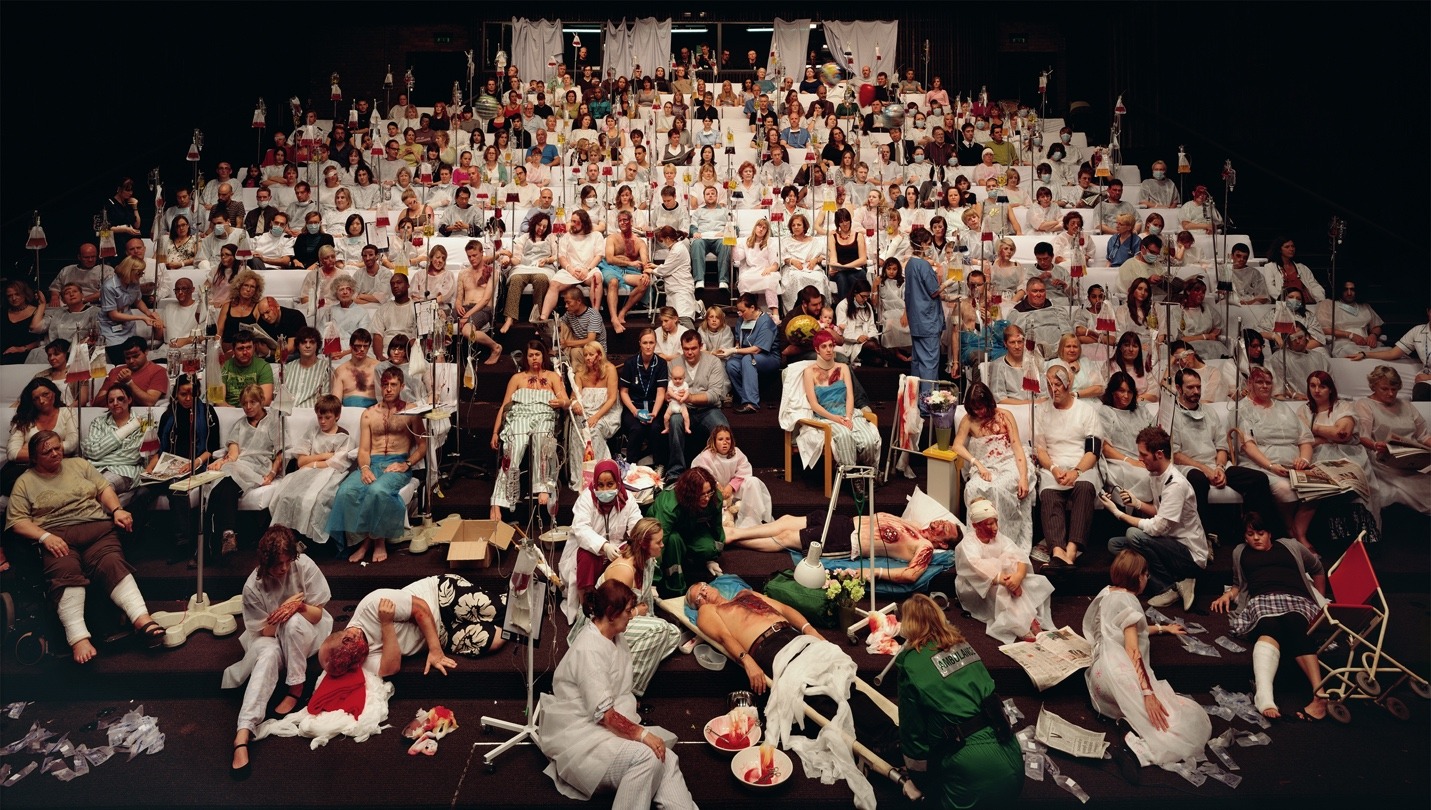
Temporary Ward, 170x300cm, 2008
When he first arrived in Beijing in 1993, right after “Deng Xiaoping’s southern tour”, Wang observed that the world around him changed instantly, e.g., a pack of dried noodles cost from 50 cents to 70 cents, to 90 cents, then 1.1 yuan. Farmers in the villages rushed to build extra houses, covering pigments over brick houses, partitioning into smaller rooms, and putting precast slabs on top for renters from outside the city. Public telephone booths, snack stores, small restaurants were all over places. Taxi cabs were driven around with ornaments in Chairman Mao’s image. Revolutionary songs were gently vocalizeded by sweet female voices after commercial packaging. The term “a guy with earthly fortune” has not been invented, while nouveau riche with the same meaning has been widely sprouting.
He couldn’t see it through, but felt something was wrong. During that period, he painted many oil paintings of human bodies intertwined in fist-fighting, or “people wrapped in plastic sheets”. By 1994, he was unable to paint any strokes. Over many rounds of chats with Yang Wei, Liu Zheng, Qi Zhilong and Hu Xiangdong every day, he settled with a group of artworks termed as “Gaudy Art” by Li Xianting featuring imagery of radish, cabbage, flashy red and green colors, ceramic cups, and etc. oil on velvet, or occasionally adding some photo collages.
“So tacky,” spectators inside and outside the art circle commented. He never refuted. At that time, magazines and monthly calendars were just as fancy and funny. The artist was just satirizing the tacky with its tackiness, a strategy to differentiate himself from the genre of political pop trendy at that time.
It was not very long before his small clique disbanded. The direct portrayal of “gaudy life” slowly developed into his distinctive features as an oil painting artist, which he finally gave up. Since 1996, Wang Qingsong confirmed that photography would be a more “powerful” tool in his art-making.
East and West, Gains and Losses
The motifs of Wang Qingsong’s long-term concern is mutual scrutiny, imitation, and collision between the East and the West in terms of exchanges in materials and culture. This process develops from coherence to conflict.
In his early works, certain global commercial brands were either worshipped or targeted. The shame of being joked, disdained, and “trampled” is ready to burst out of the scarred body.
When he went abroad for the first time in 1997, he landed in UK for a solo exhibition. Unable to speak a word of English, he had to go to McDonald’s to grab a bite. After he entered the store, several plumbers in suits came here too. They ate happily and didn’t care about their dirty clothes at all. Wang Qingsong was shocked.
He couldn’t forget his first time of eating hamburgers at McDonald’s in Beijing three years ago, when invited by a friend,. They spent a huge sum of money, more than two hundred yuan, and chatted more than four hours. “That was probably the first McDonald’s opened in China. It has two floors on Wangfujing Street and 40,000 people went to eat on the first day.” He took it for granted that McDonald’s wass a luxurious Western restaurant.
Along with overseas experience, Wang Qingsong seemed to sniff out something. He would laugh if comeone had a birthday party in McDonald’s with cheerful background music. The first time he tasted Coca-Cola, he felt like swallowing horse urine. Later, it became his habit to drink a large bottle of coke every day. Further on, his teeth were a little loose. It was worth mentioning that many huge eye-catching advertisements of real estate projects selling houses and apartments with a pseudo-foreign name attracted his attention. He attributed them together as “false modernity.”
In “Competition” (2004), he uses ink, brushes, and markers to write poster-like advertisements and set up chaotic scenes of an “advertising battle”. In “Romantique” (2003), he creates a misty and flourishing forest paradise. Naked models are like angels or ladies in famous paintings, numb with clumsy movements and dull expressions. They are “grafted” absurdly into the wonderful painting classics.

Romantique, 120x650cm, 2003
Those younger generation born after 1995, after seeing his exhibition, would ask this question in surprise, “Is it overreacting and treating the West (the West material world) as an imaginary enemy?” This divergence from younger generations and collectivist aesthetics from his generation are exactly two sides of one coin in his works. Wang Qingsong does not deny the generational imprints unable to be erased from his body.
“I go to Chairman Mao’s Memorial every 10 years. It is not for worship, but a habit. Although the epoch brought too much confusion between black and white, right and wrong, my memories during growth in youth cannot be erased.” For others who listened to the song “On the Field of Hope” in the 1980s., either it is encouraging or outdated, Wang felt just right because he lost his father at that time which dragged him out of a deep valley.
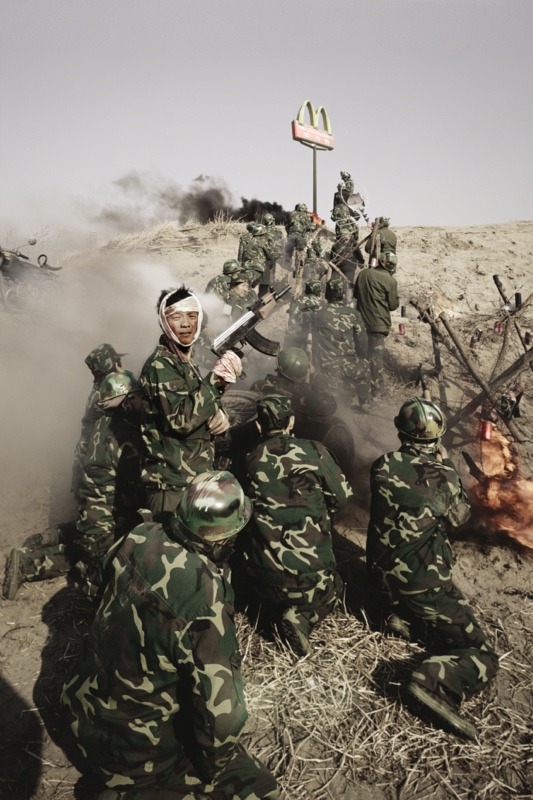
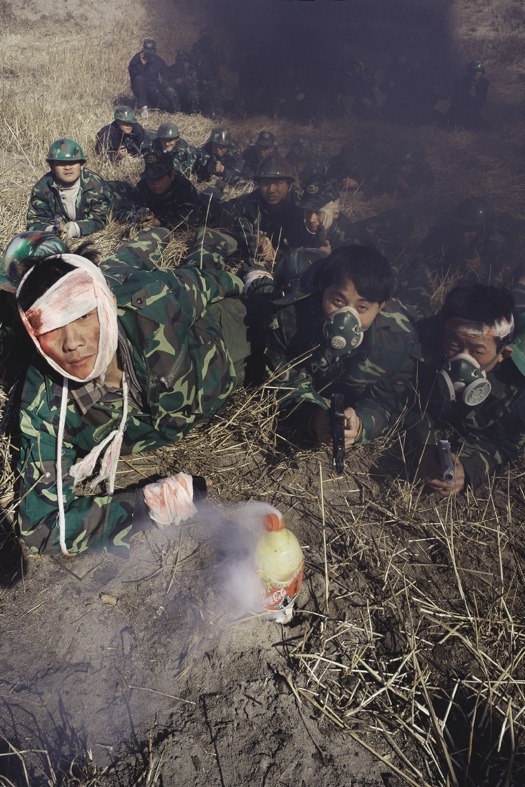
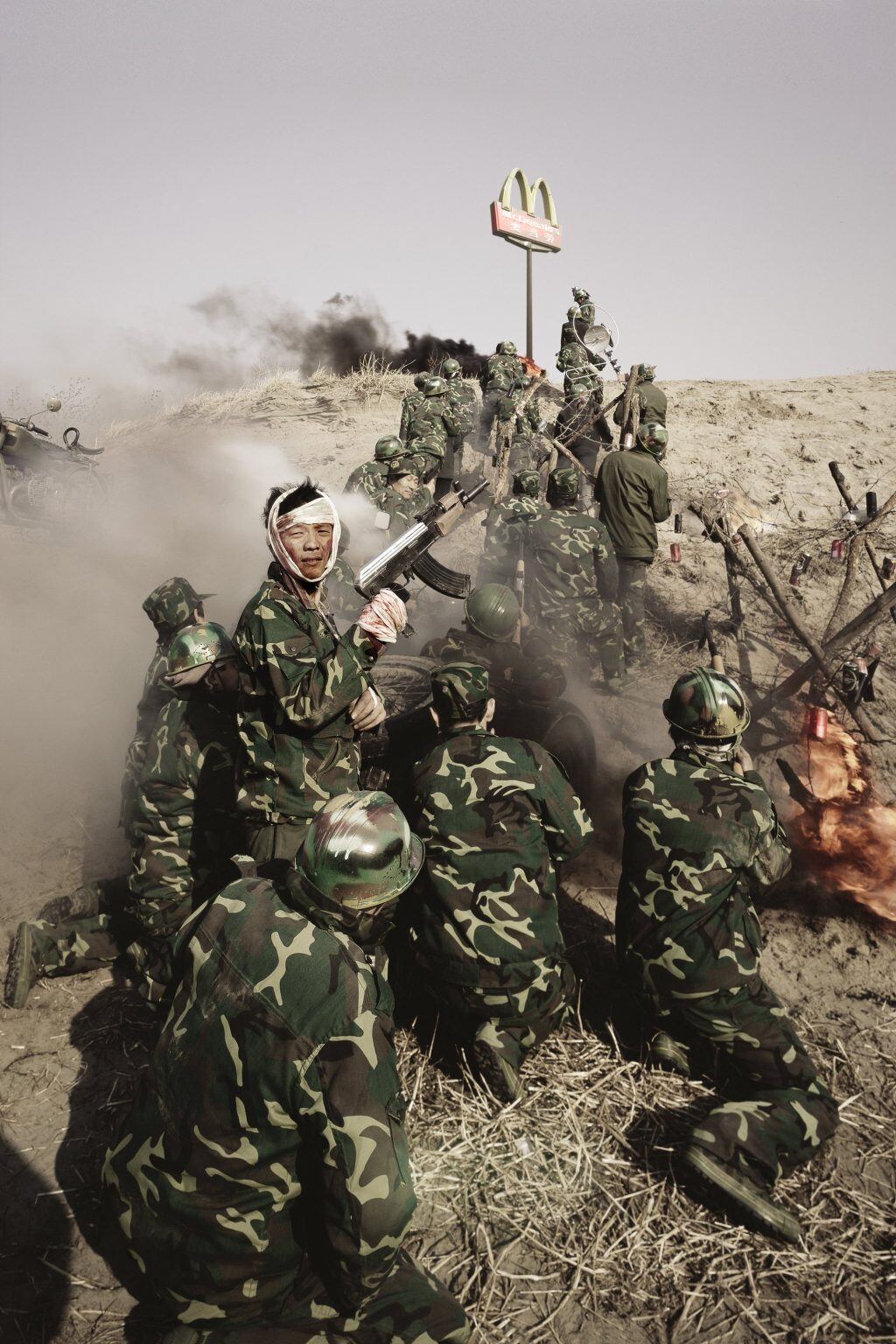
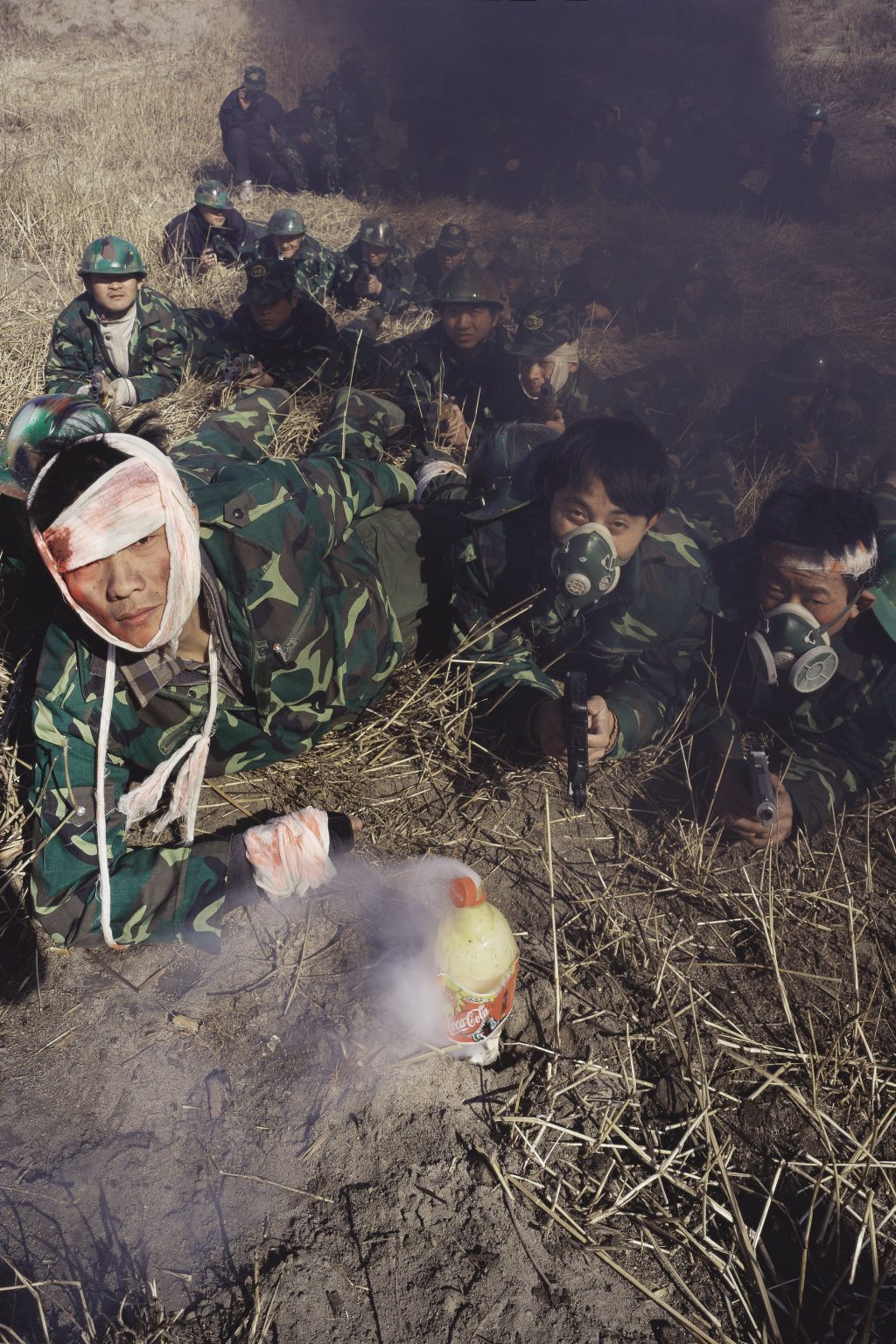
Another Battle Series No.6, 180x120cm, 2001
Time flies. A few years later, the commander in “Another Battle series” (2001) who was bandaged to take over the highland, has a mixed feeling of love and hate for his “enemy”. The photo work “Question a Brick Wall” (2020), completed in the first half of 2020, is also a composition of logos on the Fortune 500 list. The doubts and objections in the early years have turned into calm questions. Wang Qingsong, the thinker hiding in the dot of the question mark, does not bear any sadness or righteous indignation as in the past.
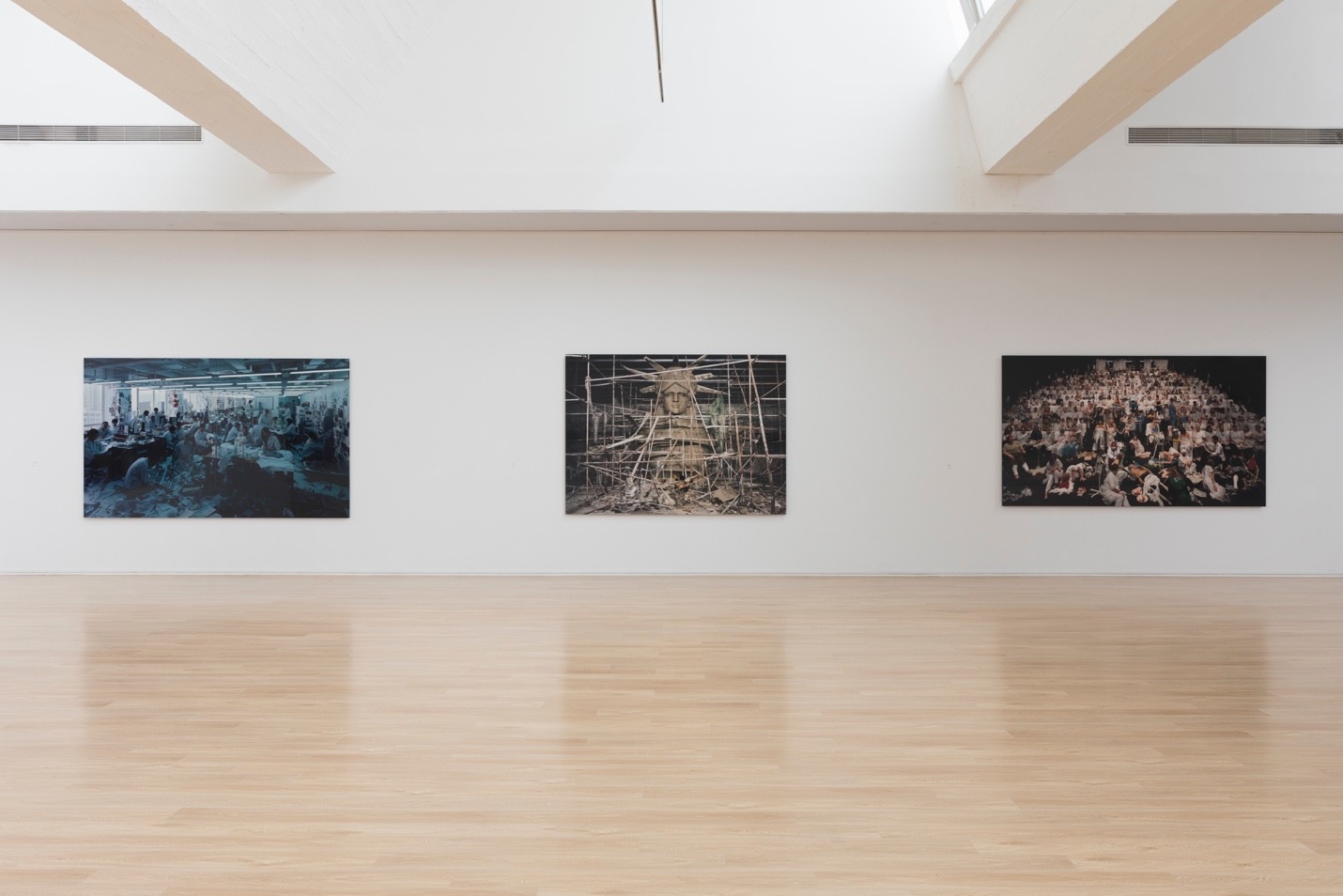
“Western consumer culture has really changed a lot of our concepts. Traces of destroying tradition are penetrating everywhere. However, it seems inseparable from our everyday life. Look at this pandemic. There are few choices for dining except those well-known western fast food restaurants.” Standing in front of the installation of “Question a Brick Wall”, Wang sighed.
Speaking of this vulgar and fat “Buddha” with hands stretching into the air, one sees a lot more divisions, revelations, castrations, and hybridization through displaced statues of saints, cigarette cases, and a face in the broken mirror.
“It’s hard to tell what kind of person this is. In fact, each of us benefits a lot from this commercialization and neither of us can be completely isolated from the outside world. You see what he throws (to the ground) is what he takes. What he obtained were thrown back to the garbage dump.”
In this contemporary art world, Wang feels exactly the same.
He has met several Western curators who know and love his work, including Francois Hebel, the artistic director of Recontre de la Photographie Arles. “Some curators in the West also hope to showcase wonderful works to resist Western centralism. They like to find something vigorous and vibrant in other places.”
But he gradually felt that as he won awards at the international photography festivals, “hostility” from the West was also growing. “When you are very weak, they are willing to help you. At a certain point, if you are better than their western photographers, they will never believe you. Some even try to stop you. Think about this more seriously! At the beginning, we learned only the surface, or even misunderstood the West. After a long time, we reflect on this learning process, finding it colliding with our own foundation. Nowadays, the younger generation goes out early and may have learned the best of the West. But learning, I am afraid, will be at a loss afterwards. So, what should we do next?”
A Photograph that Changes Destiny
“Night Revels of Lao Li”, made in 2000, was probably the work that best appropriates a tradition classical piece and wins him the most applause. This work, nearly aborted, became a turning point in Wang Qingsong’s half century’s life journey.
The photo imitates Gu Hongzhong’s “Night Revels of Han Xizai”, with five scenes assembled into a long scroll. Only a pipa was replaced by a guitar and Han Xizai’s hand-washing was changed to Li Xianting’s foot-washing. No real washing foot of course. The pair of socks was still on Lao Li’s feet.
In Wang Qingsong’s view, at the turn of the century while the economy was booming, and personal wealth surging, traditions faded out and new things kept emerging. The entangled concerns of intellectuals were very similar to Han Xizai’s unease in the Southern Tang Dynasty. “Are the times getting better or worse? Where are your ambitions? What are you going to produce for this society?”
Originally, he wanted to invite his friend Lao Guo (Yiling) to play the role of Han Xizai, but he felt that Lao Guo was a bit like a gangster. Then he thought about Xiao Feng, but Xiao’s beard was just not right. Li Xianting recommended himself, “Should I come?”
“Okay.” Wang Qingsong was pleased, but he did not reveal his shooting details, fearing that Lao Li would object.
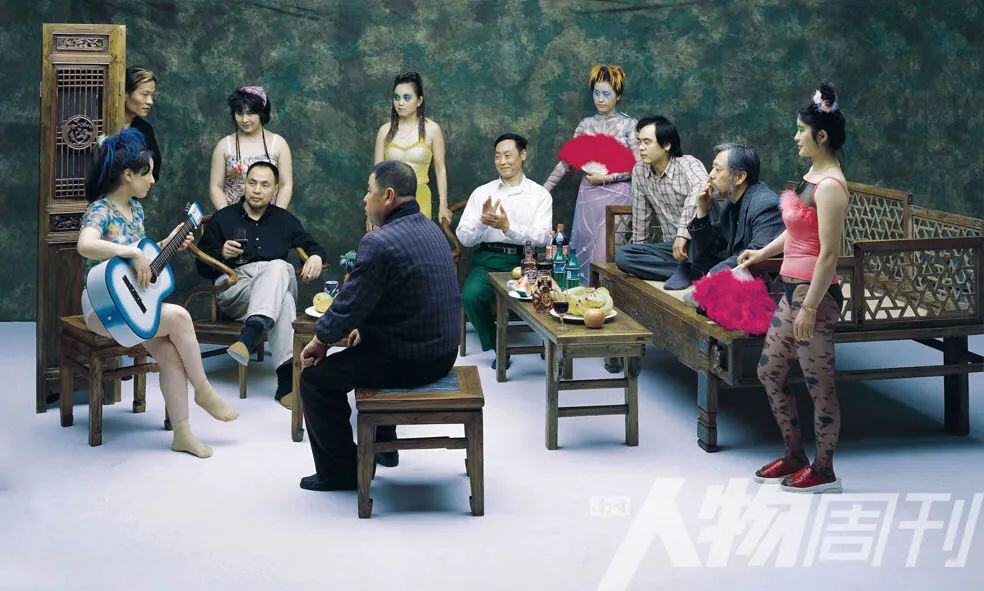
The elegant and slender lady singers in the original painting were played by some women with fat waists and legs in his photograph, stretching in a pom-pom tank top and spotted stockings, holding a rose red feather fan, pedaling red slippers, in red, yellow, blue and green wigs, as colorful as cockscomb feathers. The looks in their eyes were even more stunning. So dumb!
Lao Li was a little confused after attending a friend’s birthday party the night before. Unexpectedly, this look fit well with the expression of “sorrow” and exhaustion that Wang Qingsong wanted.
When Lao Li saw these models, unprepared, he asked Wang Qingsong secretly, “Where did you find these people? So outlandish?” Wang Qingsong explained that these were just models. Lao Li thought about it, looked at the “combination”, and felt “quite interesting”.
“To change to foot washing is also very good. Because washing hands will block the view of people behind. As Lao Li’s feet were washed, the people in front row squat down and the blocking problem wass solved.” Wang Qingsong was very satisfied.
It was only an hour before the end that Wang discovered that the “photographer reversely installed the film”. When Wang Qingsong saw the final rescued film, he felt reassured that fortunately he asked for a reshoot.
A few days later when he was developing photos, some painting friends asked him to go for a dinner. They said, “hey, hurry up! Come to eat. What the heck you take photographs? When I unrolled the film at the dinner table, I felt a very obvious expression on their faces. Damn! This bullshit made it! They froze stiff! It was such a long film! Plus, Lao Li participated in such a big performance. It means that at least (Wang Qingsong) this guy has already made a leap forward. Many foreigners who saw the photo later were also surprised because it was the first time some one in China used scattered perspectives to shoot a scroll. As for the cultural background, they have no clue whatsoever.”
In 2002 Pingyao International Photography Festival, although Wang Qingsong did not win the prize, many directors of photography festivals visited his exhibition and approached him personally. In 2008, the autumn auction at Christie’s in London sold his work “Follow Me” for 5,896,500 yuan. Since then, he was nicknamed “China’s most expensive photo artist”.
Pain
To date, Wang Qingsong has created only 99 large-format photos, an average of no more than 5 works per year. He always conceives of the text or picture first, then draws the sketches, designs poses, postures, and costumes for a few up to hundreds of characters. Then he finds the location to shoot, construct stage sets, prepare for all props, and try to add more ideas into each step of this whole process.
Until the scenes are set for shooting, “subtraction” begins during rescheduling. The height of the camera and the composition of the photograph must be determined by the artist. Usually he won’t tell models who the director is and what ideas the director wants to achieve in case more and more “commerce-driven” models raise their prices mid-way. Such lessons teach him a hard way. If there are such emergencies, certain people and installations can be removed to ensure that the shooting takes place. Usually he must prepare two to four films for each work. Next, he will scan the positives as large as one gigabyte before printing out the work. “My photography reflects on the issues from this commercial era. So, its quality of texture cannot be worse than it.”
Unlike the usual photojournalism series, what Wang Qingsong does is to concentrate on the changes and conflicts in one single photograph. “Traditional photographers may take 20 to 30 years. But I will analyze what these 20 to 30 years happened. I want to check on a lot of information and reveal the authenticity with one single film.”
“Follow Me” was a TV show that swept the country in the 1980s. It was obvious how popular it was to embrace the West by learning English all across this country. Wang Qingsong’s photo with the same title was created out of an unintentional “promise.”
“At that time, a friend of mine filmed a lot. Every weekend, he would spend lots of money in shooting pictures. I said to him, “I would film only one which will definitely be cheaper than yours, but not worse than yours.” Wang Qingsong put up a piece of plaster board, 4 meter high, 8 meter long. Using ink to blacken the board, writing with colored chalks costing 3 yuan only, he covered the whole blackboard with both Chinese and English quotations, slogans about SARS, World Expos, Biennales and other current worldwide events. The contents covered his lived experiences in the last decades. He said to his students, “If you don’t have money, then you have your time. Time is the most needed cost in this era.”
In shooting “Follow Him”, the books were purchased from a junkyard, weighing more than 20 tons. Unloaded one by one from the truck, they were, with dust, placed on the bookshelf to be sprayed with water and rice soup later for moist and mold, He waited for months. “It was summer, and the books were more prone to mold due to moisture. This would show the shabbiness in the photograph. The staid old man in the reading room (played by Wang Qingsong) finished reading thousands of books, and still didn’t’t know what knowledge is really about. What is the purpose of reading them?”
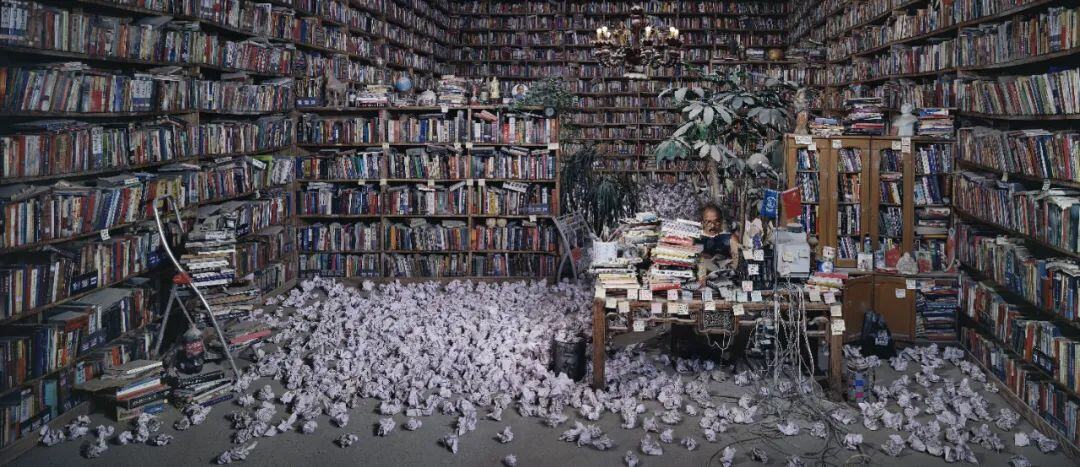
Follow Him, 130x300cm, 2009
During the six months of lockdown due to Coronavirus, he spent four months depicting hundreds of corporate and institutional advertisements in “Question a Brick Wall”. Sitting on the cloth sofa, he worked as long as 10 hours to finish only 3 sheets every day. When painting, his legs were folded and spread out on a stool. His head lay over the table diagonally. At the end of the day, his hands were shaking and back aching.
Take the poster he made of Tate Modern in U.K. as an example. Each letter consisted of numerous small circles. He carefully sketched out the contours, traced the shapes, and painted each one of them with colors. In some cases, he needed to outline them again. When these posters were pasted on a seven or eight-meter-high wooden board, it was almost impossible to see the difference between a thinly painted dot and a directly printed dot.
“No assistant?”
He smiled. “Where can I find someone during the pandemic? The only assistant is busy looking up information, printing logos, and doing other tasks. Besides, I have to do this all by myself.”
Starting from “Competition” in 2004, he must do it himself when it comes to painting.
“I have always said that I make photo works like producing compressed biscuits. If the work is achieved by the team via a lot of money, it will become more and more alienateded from the artist. And I believe when I paint, there is another eye watching me. Nowadays, watching many blockbuster movies does not exert any feelings on audience. Why? Because even if he was punched very harshly, he flew up to dozens of meters, fell down, but still alive. It is very exciting, but there is no pain. We still hope to see shots like in “Shaolin Temple”, that one is bleeding after being beaten up with one heavy fist.”
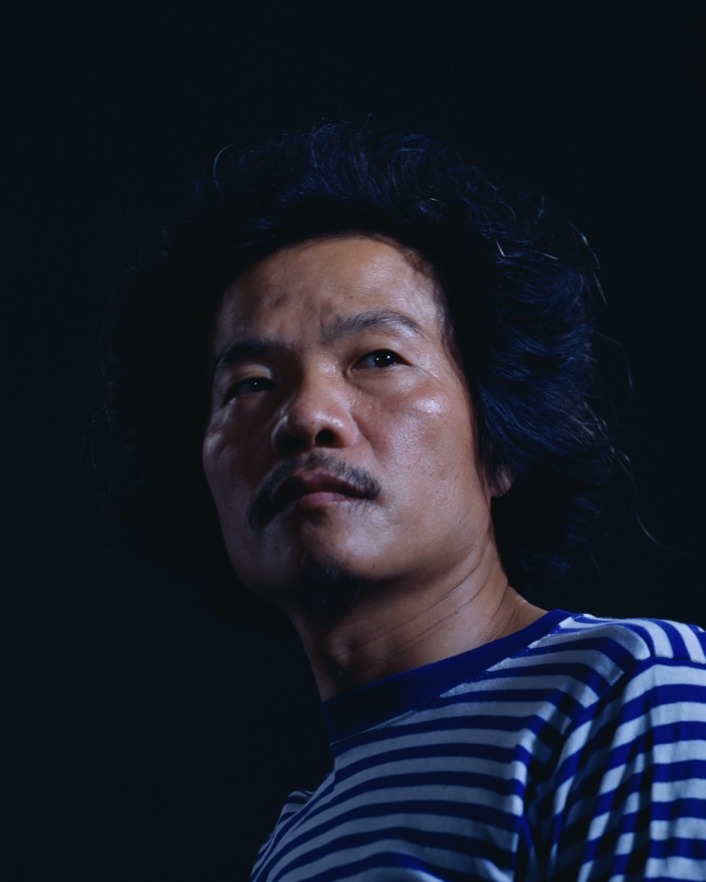
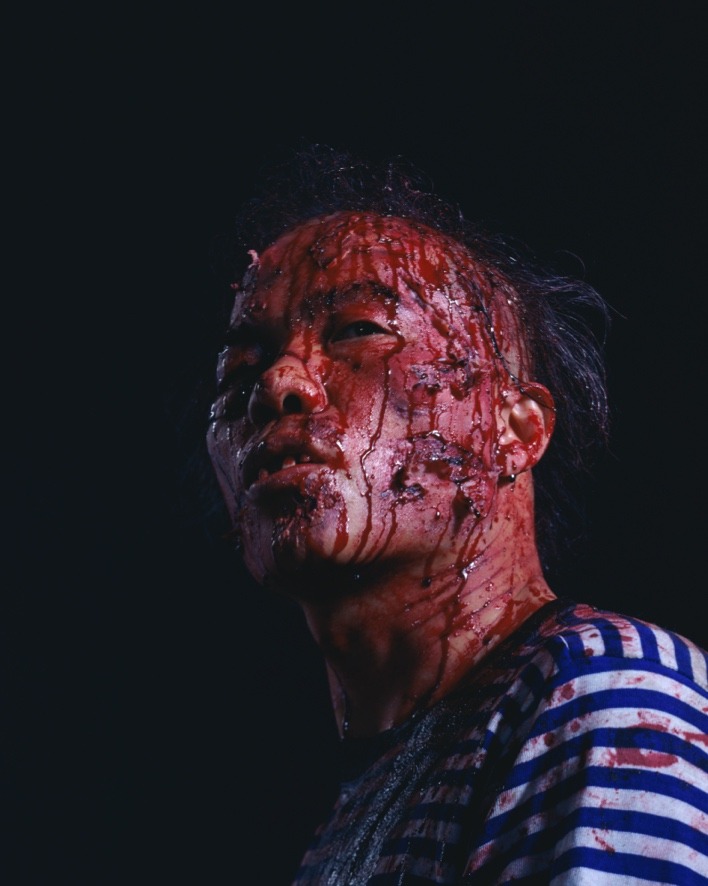
Iron Man, diptych, 150x120cm x 2 pieces, 2008, also a video, 4 mins, 35mm, 2008
Wang rarely does post-production for his photo works. Over these years, the most important post-processing is to reduce the saturation by 30% to 50% before printing final photographs. Although gorgeous colors and desires are still there, these works carry more gloomy and sad mood.
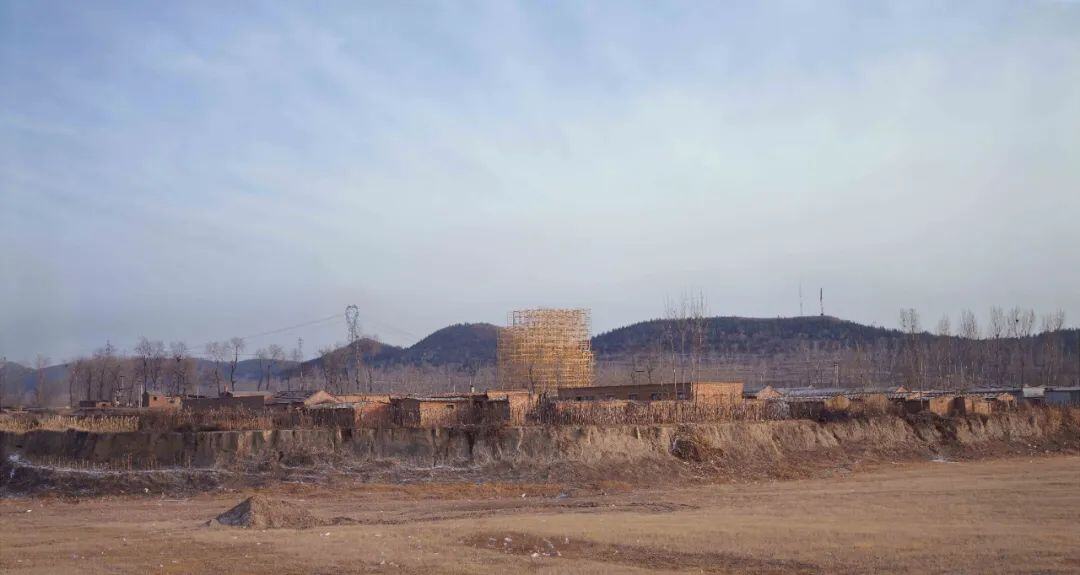
Skyscraper, 120x225cm, also a video, 5’, 35mm, 2008
In 2008, Wang Qingsong shot three short films. In filming “Skyscraper” at a rural village of Changping Township, in the suburbs of Beijing, he directed workers to build a “skyscraper” with a scaffolding structure of 50 meters in diameter and 38 meters in height. The video recorded the time-lapse process of laying the foundation, erecting, completing and celebrating this empty structure. In the accompaniment of “Silent Night”, a Christmas carol, clusters of fireworks were blossoming on its “top”.
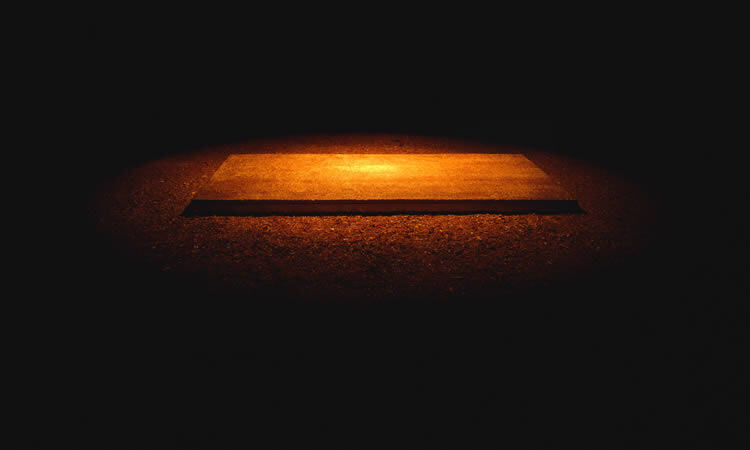
In “123456 Chops”, a mysterious man in a sick patient garment threw a dead sheep on a chop board. With only one dimmed lamp, he spent 10 hours to dismember the sheep into minced meat. In “Iron Man”, a man, wearing a seafaring T-shirt, is beaten up by countless heavy punches from different directions. He dodged and confronted. He bled all over his face (a makeup effect). Until his teeth and hair fell off, this iron man smiled at the end at his opponent.
123456 Chops, 120x200cm, also a video, 4’, DV, 2008
In Cui Cancan’s interpretation, the emptiness, depression, and fear in these works convey the common dilemma of everyone at the moment. “In terms of changes in subject matters or value orientation, Lao Wang has been more vague than ever before. The pop song “On the Field of Hope” inspired him in his youth. Today, many people lose their coordinates. Where is the hope for the future? No one can give this revelation. Reality makes Wang suddenly realize that it is no longer possible to make a simple response like 20 years ago. Relying solely on photography may not be sufficient to express his meanings.”
Forever an outsider
The exhibition is being installed on the day of the interview. Wang Qingsong clung to his flip-flops. Dressed in dark camouflage pants, he does not match the nickname of “art nouveau”.
Looking at himself in “Bequeathing Buddha”, he laughs at himself, “He’s much more greasy with 40 kilos heavier than before. You see (raising his hand)! The arms changed directly from a shrimp to a crab! Ha-ha!”
But he is so proud of himself that many stronger people fail to beat him in wrist contest.
“True Gig” comes from his early life in the drilling career.
Born in Daqing, he returned to his hometown with his father who worked in Jianghan Oilfield. After graduating from high school, he took up his father’s job and worked in the drilling team for seven years.
On a shift of 12 people, his everyday life was to drill wells, change drill pipes, and repair parts. From 4 a.m. to 4 p.m., he worked for 12 hours, staring at the machine constantly.
There is no touching story of “tempering his will”, but the deep scar came from “the aftermath of fear for accidents”. He can’t forget that a worker, accidentally mistaken the clutch when lifting the drill pipe, was swept to death by unhooked iron bump (ring). Or his colleagues, during welding things, touched upon water, and hands were electrocuted. From then on, he would go around the telephone pole when it rained.
Later both parents were transferred to Jianghan Petroleum Institute. His father cared the flower garden at a service company, and his mother painted the classroom tables and chairs. Inexplicably, he became interested in painting, and staggered to get into Sichuan Academy of Fine Arts.
In 1993, Wang Qingsong came to Beijing by bus holding 1,200 yuan. This newcomer to Beijing wrote three diaries on a hard-cover notebook, documenting his Journey to the North.” He dreamt to make a big deal.” After three diariess, he wrote no more. How Stupid! “Lao (old) Wang” laughed at “Little Wang”.
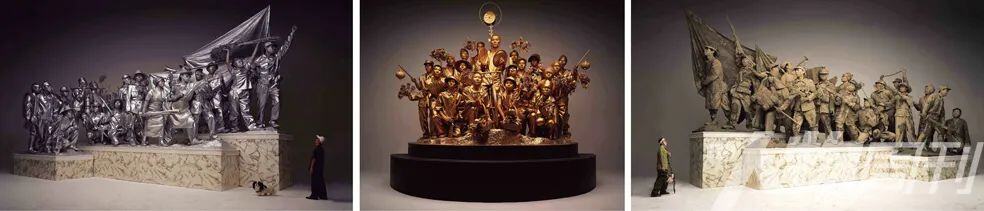
Past, Present and Future, 175cm×(291cm+281cm+291cm ), triptych,2001
During the winter, he lived nearby the Old Summer Palace. He bought 200 kilos of Chinese cabbage for 20 yuan as buying in bulk was cheaper. He almost threw up as he ate too much cabbages. The rooftop near his bed leaked. The rain poured in. He must bear with the trembling roof. Later, he moved from the Fragrant Hills, to East Dongbai River, and then to Songzhuang. He never felt settled. In one year, he had to move 5 times. “As long as someone makes a higher bid, the landlord will kick us out. Sometimes if I don’t pay attention, my belongings will be stolen. Local villagers are not friendly to us.”
One time during the New Year, he really wanted to visit Lao Li (Li Xianting)’s house. “Looking at a box of oranges costing 15 yuan, I hesitated as I have only a few dozen yuan left. Forget it, I won’t go.”
When he finally entered Lao Li’s house, Lao Li pointed to his sofa and told him that Luo Zhongli, Wang Guangyi, and Fang Lijun all slept in the sofa. “I was so excited when I heard that. Imagine myself to be one of them in the future. But I did not have anything. Lao Li said to me, “if you don’t have any money, come here and have a bowl of noodles. It doesn’t matter. “
But no one can depend on big brother forever.
Before shooting “Night Revels of Lao Li”, walking back home with a bag of props, he was stopped by the “police”.
“I told them I was a teacher at the Central Academy of Fine Arts. I live in a place 20 meters away. One person said, “just you, a teacher of the Academy of Fine Arts?” They figured out I was not from Beijing as I had a strong accent and pushed me into a minivan. Many people squat as the back seat was completely dismantled. I’m the last one to come in. He told us we would be sent to Changping County for turning over sand for construction plants. After we make enough money for a return train ticket, we will be sent back to where we come from. “However, if any of you can turn in 200 yuan, you can leave right away.” Holy Crap! I took out 200 yuan from my butt pocket and gave it to him. He said me, “Fuck off”.
Since then, Wang Qingsong never felt at ease if he went out alone.
“That’s why I had this hairstyle.” Wang Qingsong pointed to his head with “wild grass.” “When someone sees my hair like this, he thinks I am really sick. I might have cancer or something serious. So, he won’t ask any more.”
This trick actually worked. The chance of being stopped and questioned is greatly reduced.
“We saw his head, all laughed hilariously. This is it! The only one.” He Yunchang, a longtime friend and performance artist, smiled and stopped. “When we first met Qingsong, all of us were very arrogant and motivated, thinking in our hearts that the future belongs to us. It’s that simple. The earth is under our feet. Now Look at his hair. It hides the artist’s wisdom and helplessness. This society is so unreliable.
After this “trial”, Wang Qingsong further strengthened his faith of “creeping forward”, a strategy he followed since he moved to Beijing. “I have just arrived and don’t know anyone. I must move forward. If not, there will be no chance. But one has to lie on his stomach and crawl forward. Don’t raise your head.”
In 2007, he rented a 400-square-meter studio in Caochangdi for 20 years. That money could buy a big house in Wangjing Area. He felt secure with this studio, reassuring him that he was lucky in the end. Even if life is full of variables, anyone can be overruled by a minor mistaken presumption.
The caution and anxiety brewed from life experiences linger on, ceaseless like the increasing wrinkles on his forehead.
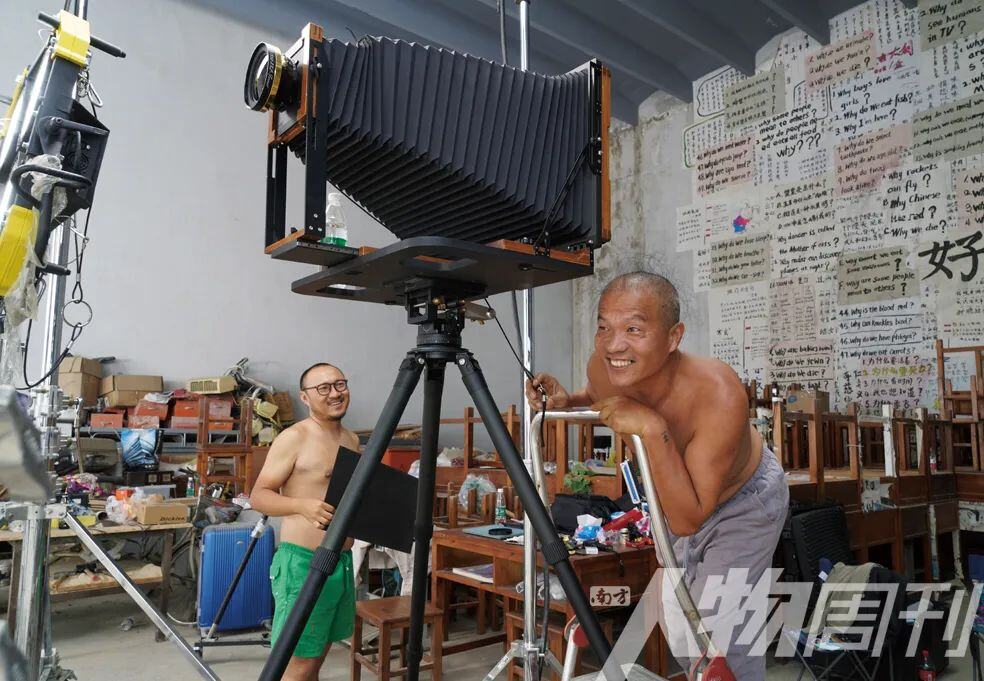
Zong Ning and Wang Qingsong
After shooting the last negative of “Question a Brick Wall”, Wang Qingsong was in a great mood. Hence this working photo. As this new work was created indoors. Without models, it is much easier to control. He felt more relaxed. Shooting a lot of works which require outdoor sets, construction, communication, model management and etc. is very demanding, tiring and frustrating as many situations pop up.
Fate
After shooting each work, the team would celebrate and have fun for a big meal. Each time, Wang Qingsong prefers to smoke a cigarette, stay quiet and fall asleep. Once the tension and excitement in the early stage are released, the sense of overdraft will suddenly hit. Probably because of his coming age, fatalism is haunting.
He often thought of his father, mother, and younger brother. None of the three walked away peacefully, out of expectation.
When he was a child, he never called his dad. He had a dark complexion. He felt because he was ugly, therefore his father disliked him. When the father came back from the night shift from the drilling field, he saw his oncoming son. Wang would turn his back and pretended not to see his father. “He keeps saying to me that I am finished, and this kid will be hopeless.”
When he was 14 years old, Wang had so many grudges against many things. His dad was so angry that he beat him and went out to work. Back home again, he returned as one dead body from a car accident on a business trip. Separated by Yin and Yang from his dad, Wang Qingsong’s youthful rebellion stopped abruptly.
“When my father was cremated, the funeral staff used tongs to stoke the fire. The body was burned into half a skeleton. Suddenly, I saw my dad sitting up. At that moment, my soul was taken.”
After his father passed away, his mother was in a bad mood. Once she scolded him. In the middle of the night, he ran to the moat of Jingzhou, and walked into the river. When the water reached his chest, he suddenly heard a frog’s “quacking”. He returned to his consciousness.
When shooting “Night Revels of Lao Li”, he had a very hard life and his creativity faced a challenge too. He took the compension money from his mother’s death, salaries from the last few months, and intended to make a desperate move. It wasn’t until the last shot was finished and the film sheet couldn’t be taken out that he realized the negative was reversely loaded. “But at any rate it’s reshot. I think because I was using my mother’s compensation money, this money will not be wasted. The deceased’s money shouldn’t be taken away. If installed reversed and not retaken, it will definitely be doomed for failure.”
The death of his mother finally assured Wang Qingsong that he needed a settlement. He got married, had children, and did not migrant anywhere.
But it is strange that he never dreamed of his father and mother. “I always want to have a dream of what they would tell me. But I could have all sorts of dreams but I never have any dream about my parents. Are they angry with me or what? I don’t know.”
He Yunchang said that Wang Qingsong was very generous and kind who puts his family on his top priority. “So he will struggle with these concerns. However, a powerful artist will eventually detach himself and realize he should rise above himself and convert his role into an artistic creator.”
Is Wang Qingsong detached? He is fascinated with Dante’s “Divine Comedy”. What does heaven and hell look like? He always wants to shoot this subject matter. But he never has the chance. He says, “As long as people live, they will suffer. No one can be exempted. Social changes happen on the surface level. It is difficult to express what is really inside even if its impact is palpable. I often feel that the moment one creates art at the earliest time is the one moment when he leaves this world. The power of art refers to that feeling for life.”
“One day, I will shoot “The Divine Comedy”.” As he said, he squeezes out the cigarette in his hand.