
Pictures and Perspectives: The contemporary photography of Wang Qingsong, Muchen and Shao Yinong
2020Pictures and Perspectives: The contemporary photography of Wang Qingsong, Muchen and Shao Yinong
By Sam Beard
Published: December 2, 2020 | Source: Guan Kan: Thinking with Contemporary Chinese Art
After the conclusion of the Cultural Revolution in 1976, a wave of independent and avant-garde exhibitions rocked Beijing’s art circles. Photography became an important medium for the expression and documentation of personal histories in China, and often a means for oblique social criticism. The contemporary photography of Wang Qingsong (b. 1966), Muchen (b. 1970) and Shao Yinong (b. 1961) is imbued with this history. This essay traces the evolution of Chinese photography and critical discourse in the late 1970s to interpret the contemporary work of these artists.
By 1977, the Beijing Spring was sweeping across China’s political landscape. The Beijing Spring was a brief period of liberalisation which resulted after the death of Mao Zedong and the purging of political faction the Gang of Four the previous year (Gladston 2014, p. 84). This radical political shift concluded the Cultural Revolution and permitted Chinese citizens to openly criticise the Chinese Communist Party for the first time in years (Gladston 2014, p. 84). This period saw many turn to photography as a means of expressing their criticisms, personal histories and experiences during the Cultural Revolution (Roberts 2012, p. 121). The rise of ‘people’s photography’, was due to individuals from politically or culturally influential families who experienced the devastating impact of the Cultural Revolution.
The photographers’ approach was a kind of creative documentation, recording their individual lived experiences and perspectives on contemporary China (Roberts 2012, p. 121). There were many catalysts for this dramatic social and creative change. One such event was the public protests of Tiananmen Square on 5 April 1976, prompted by after the death of long-serving Premier Zhou Enlai (Gladston 2014, p. 95). Followed by the death of Mao only five months later, this was a time of mourning, of cautious openness and political soul-searching (Roberts 2012, p. 121). Two years later, in December of 1978, the assessment of the Tiananmen Square incident as a counter-revolutionary movement was overturned by China’s Central Council Community Party. The party announced the end of “class struggle” and the start of “socialist construction and modernization” due to the current need and desire to “liberate thinking, free people’s minds, and seek truth from facts” (Roberts 2012, p. 123).
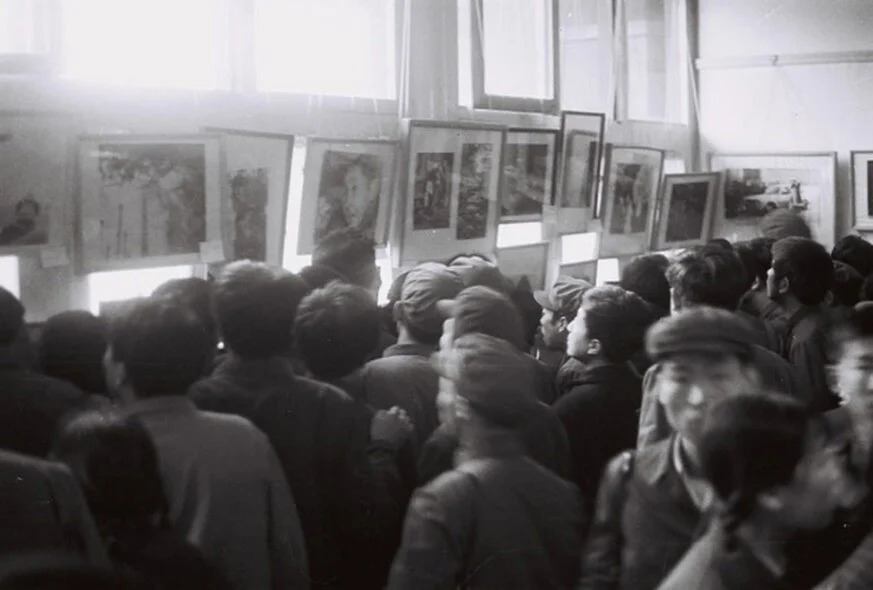
Such events would become part of the creative vernacular for artists of the period. The milestone exhibition Nature, Society and Man is one such example, staged by the April Photography Society in Beijing, April 1979 (see Fig. 1). The Society derived their name from the April 1976 Tiananmen Square protests, which many of the group documented in their photography (Roberts 2012, p. 129). Running for twenty days, the exhibition brought large crowds and was the first of its kind to be organised by an independent community organisation in three decades (Roberts 2012, p. 129). The exhibit attracted an estimated seventy thousand people and was touted as having no political agenda, instead favouring individual expression (Chen 2017).
That same year, Li Xianting (b. 1949) published a seminal article critical of Chairman Mao’s views on aesthetics. Editor of the art magazine Meishu at the time, Li covertly circulated the article, which directly responded to Mao’s famous talks at the “Yan’an Eorum on Literature and Art” in 1942 (Cohen 2010, p. 85). Li’s article challenged Mao’s official artistic dogma of Revolutionary Realism, with Li “support[ing] personal art – art created by people who express themselves and not Mao’s dictum that artists are expected to work for the whole of society” (Cohen 2010, p. 85).
Months later, the art group Stars (Xingxing) broke onto the scene. One of the first significant art movements to surface after the years of the Cultural Revolution, the Stars included Huang Rui, Ma Desheng, Wang Keping, Qu Leilei and Ai Weiwei (Cohen 2010, p. 85). With Li promoting the group, he recalled using “the [Meishu] magazine to recommend all those new artists for the big Stars exhibition” (Cohen 2010, p. 85). The Stars exhibition, staged in September 1979, was the first unofficial public exhibition to openly dissent from the prevailing socialist realism imposed under Mao, as well as presenting loosely disguised criticism of the Cultural Revolution and Mao himself (Gladston 2014, p. 93). Staged outdoors, many of the works were displayed adjacent to the National Art Museum.
Both the Nature, Society and Man and Stars exhibitions of 1979 agitated numerous debates within arts circles. Organiser of Nature, Society and Man, Wang Zhiping (b. 1947), separated ‘art photography’ from ‘news photography’ in the introductory statement for the exhibition presented in the gallery. In the statement, Wang declares that the “beauty of photography lies not necessarily in “important subject matter” or in official ideology, but should be found in nature’s rhythms, in social reality, in emotions and ideas” (Chen 2017). In contrast, the Stars exhibition was so overt in its criticisms of the government that it was shut down within two days (Gladston 2014, p. 94). Following several public protests, the Stars were permitted to restage the first exhibition at the Huafang Studio, Beijing, attracting over two hundred thousand visitors over the ten days the show was held (Gladston 2014, p. 98).
In many respects, Wang Zhiping and the April Photography Society’s desire to depoliticise photography and emphasise individual expression may initially sound at odds with the aims of the Stars. However, a closer reading reveals deeper similarities. For Wang to suggest an emphasis on form over subject in photography effectively contradicts the aesthetic espoused by Mao. The agenda of the April Photography Society also mirrors Li Xianting’s support for ‘personal art’ and many of his criticisms of Mao’s aesthetic dogma. This era sets a crucial precedent for art in China, and for many would be considered the beginning of contemporary art in China (Gladston 2014, p. 93).
Under the leadership of Deng Xiaoping, China would undergo enormous economic and social transformations over the proceeding decades. These included social reforms and development of economic trade, with such policies as the ‘Four Modernizations’ and the ‘Liberate Your Thinking and Search for the Truth in the Facts’ directive (Gladston 2014, p. 85). However, the next generation of contemporary artists that Li Xianting would nurture soon had a very different political landscape to negotiate.
A decade after the Stars exhibition, China was in the midst of crackdowns after the Tiananmen Square massacre. Following the events of 4 June 1989 and the restrictions enforced by the government on artistic activity, many artists either relocated abroad or ceased involvement in the arts altogether (Gladston 2014, p. 166). Li was banned from editing during the crackdown and subsequently reinvented himself as a curator, supporting movements including the Cynical Realists, Political Pop and Gaudy Art movements (Cohen 2010, p. 87).
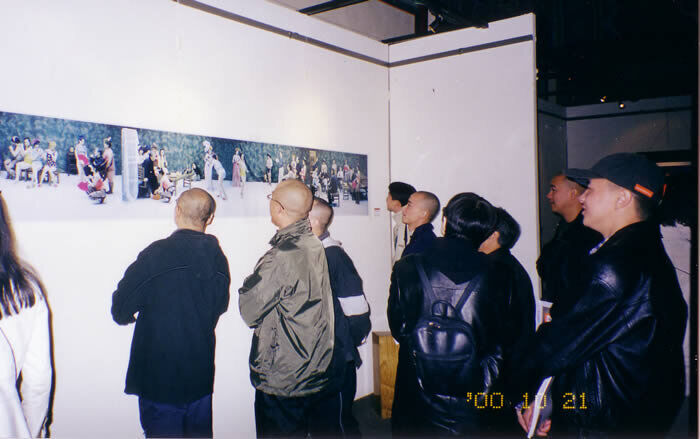
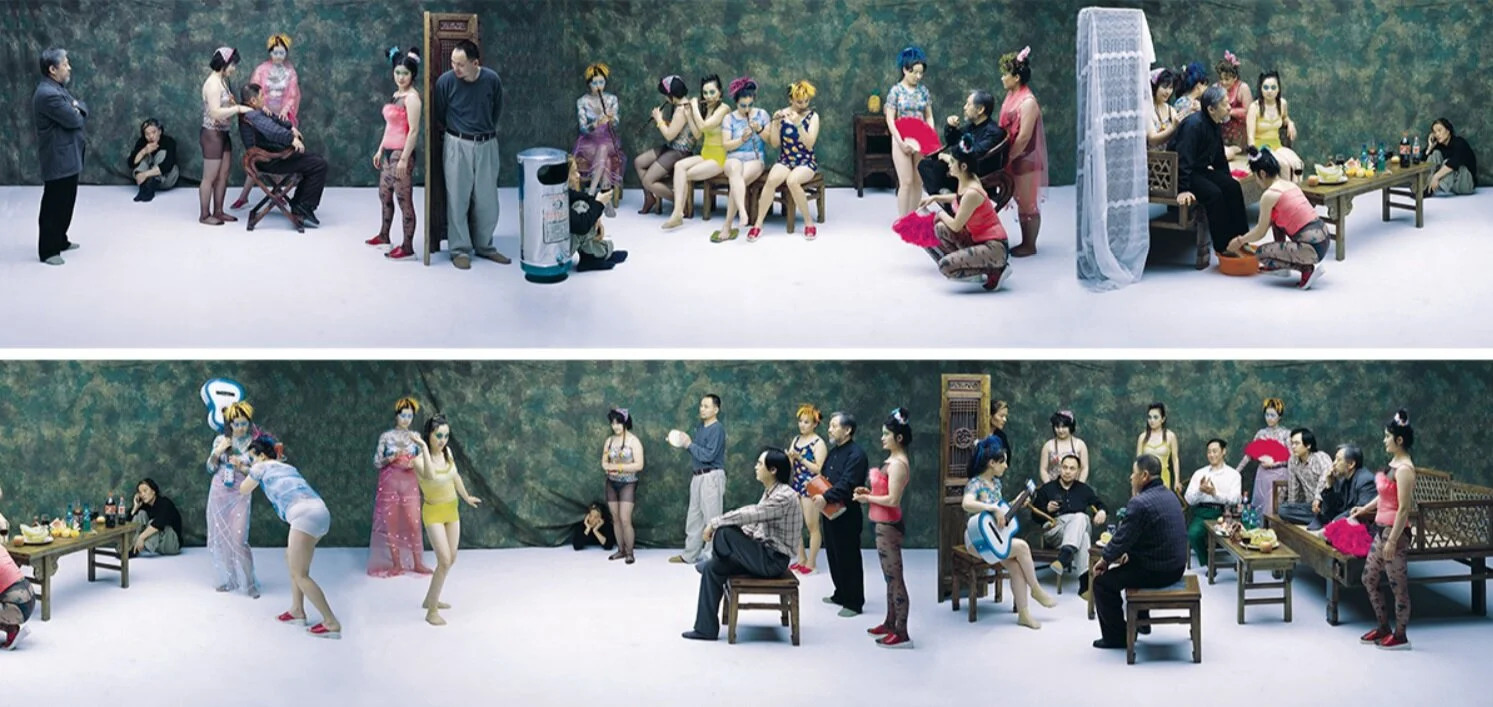
Wang Qingsong was among the up-and-coming practitioners of the Political Pop movement. Graduating the Sichuan Academy of Fine Arts in 1993, Wang’s focus was primarily in oil painting. However, he too would undergo a reinvention. Moving away from painting, Wang began working with photography in the late-1990s. Wang’s first exhibition of photographic work, Glorious Life: The Photographs of Wang Qingsong (see Fig. 2), was held at Wan Fung Gallery, Beijing, in 2000. This body of work featured many of the techniques and stylistic traits that have reoccurred throughout Wang’s oeuvre. Night revels of Lao Li (2000) is a fine example of Wang’s staged large-format photography and use of metaphor (Zhang & Yang 2009, p. 177).
Night revels of Lao Li references the well-known Tang dynasty scroll, Night revels of Han Xizai by Gu Hongzhong. The tenth century scroll depicts the Lieutenant Han Xizai’s excesses and erotic indulgence. Commissioned by Emperor Li Yu, Gu Hongzhong was ordered to attend Han Xizai’s overindulgent parties and paint the scroll from memory, thus proving Han’s excesses to the mistrusting Emperor (Zhang & Yang 2009, p. 177). Wang Qingsong considers his re-enactment “a portrait of the current position of intellectuals in Chinese society” (Hung & Phillips 2004, p. 213), referencing the powerlessness of intellectuals and their resultant escape into self-fulfilling and contained worlds created for themselves (Roberts 2012, p. 170). Wang casts Li Xianting in the place of scholar-official Han Xizai, as well as himself, as Gu Hongzhong spying on the antics of the scholar.
By appropriating the Night revels of Han Xizai, Wang creates a visual analogy between the social hierarchies of the Tang dynasty and contemporary high-ranking officials (Zhang & Yang 2009, p. 177). For Wang, the unstable years of the 1980s and 1990s leading up to his first exhibition were fuel to his creative fire, recalling in 2007, “when we were young, we learned from Mao. Then, when we left school, it all changed. So even in our short lives we’ve had to face all these contradictions” (Collings 2007, p. 89). As demonstrated in Night revels of Lao Li, historical appropriation has figured heavily in Wang’s oeuvre, and is often a device for casting analogies and oblique criticisms. In his most recent work, The Bloodstained Shirt (2018), Wang appropriates Wang Shikuo’s well-known 1959 drawing of the same name. Wang would choose Highland Park, Michigan, to restage the image of the peasants triumphantly reclaiming their land after rising up against their merciless landlord (Baecker 2018). Wang considers his creative methodology as a kind of documentary photography (2019).
Wang’s appropriations of a familiar image or event create familiar fictions, documenting particular issues or topics through speculation and metaphor. During an interview about The Bloodstained Shirt, Wang is asked about the possible parallels between Beijing and Detroit, and points out the similar industrial and economic circumstances of the two locations (Couillard 2019). In many respects, this comparison demonstrates Wang’s concept of documentary photography, allowing the image to transcend the specifics of one location, and thus address particular subjects from a more global perspective. Thus, the photography of Wang Qingsong disrupts the binary proposed by Wang Zhiping of the April Photography Society.
The distinction between art and news photography developed into a serious topic of debate after the Nature, Society and Man exhibition of 1979, appearing as one of three key issues discussed at the first National Photography Theory Annual Conference in Beijing, 1980 (Chen 2017). Wang Qingsong’s first exhibition of photography is ultimately the logical conclusion to this debate, amalgamating the two premises. In doing so, Wang inadvertently synthesises the binary of Maoist socialist realism with Li Xianting and Wang Zhiping’s desire for individual expression, exposing the two as a false dichotomy.
Artists Muchen and Shao Yinong deconstruct these ideas to a different effect. Muchen and Shao’s artistic collaboration began in 2002, photographing assembly halls that related to significant moments in the history of the Communist Party of China (Zhang & Yang 2009, p. 167). These assembly halls were communal places attended for celebrations or mass criticism meetings (Shu 2004, p. 1). These empty halls seem all but abandoned, yet they have been preserved or reconstructed by the government for tourism (Zhang & Yang 2009, p. 167). Each of these sites have been carefully repaired or restaged in order to replicate the original revolutionary assembly hall (Zhang & Yang 2009, p. 167).
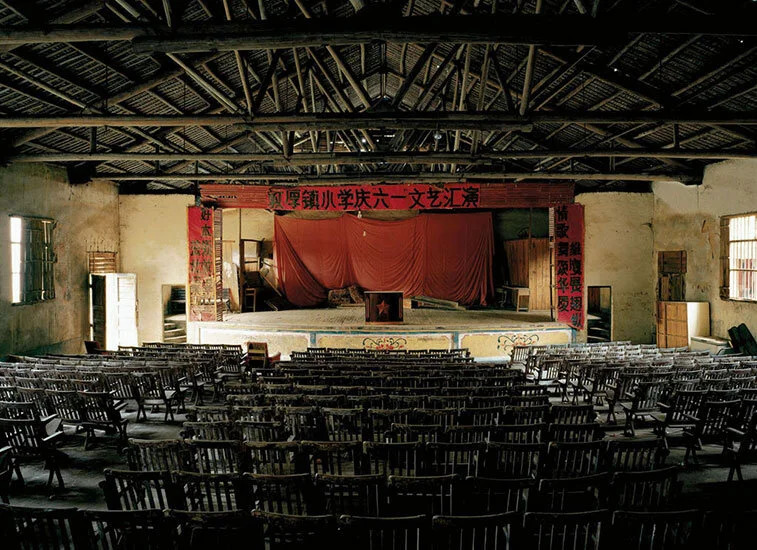
Like the work of Wang Qingsong, Muchen and Shao’s Assembly Hall series blurs documentary with creative vision, presenting a haunting documentation of the revolutionary fantasy. Art historian Wu Hung considers this kind of work ‘counter images’, refashioning the subject’s ‘official’ meaning through self-conscious appropriation (2005, p. 184). The simple execution of the photographs and downplayed artistic intervention, along with extensive literary research into historical contexts, makes their approach not dissimilar to anthropological research (Jiang 2007, p. 9). Yet, coming from a background in photojournalism, Muchen points out that although “the camera could be considered as a relatively honest and reliable tool . . . the moment when the shutter clicks would bring a subjective choice or decision” (Jiang 2007, p. 9).
By mapping the key historical contexts for the development of contemporary photography in China, two striking similarities become apparent in the work of Wang Qingsong and that of Muchen and Shao Yinong. Both their approaches to photography mediate a middle ground between the ideological and aesthetic divide of Mao and Li Xianting. Furthermore, their respective works negotiate the contemporary restrictions placed upon the arts in China by crafting ‘counter images’ and oblique criticisms through appropriation. Writing on the Assembly Hall series, artist Shu Yang proposed “that sometimes history seems to be playing a joke, but Shao Yinong and Muchen have recorded this joke with great meticulousness and in all seriousness” (Shu 2004, p. 1). For these artists, contemporary photography functions in two key ways. The first, as individual expression, be it critical or otherwise, thus dissenting from the dogma of Mao. And secondly, as a means of recording the past and calling into question the present.
Bibliography
Baecker, A 2018, Socialist Art From China, Remade in Michigan. Available from: https://www.citylab.com/design/2018/02/socialist-art-from-china-remade-in-michigan/553745/. [23 July 2019].
Chen, S 2017, Departing from Socialist Realism: April Photo Society, 1979–1981. Available from: https://aaa.org.hk/en/resources/papers-presentations/departing-from-socialist-realism-april-photo-society-19791981. [25 July 2019].
Cohen, A 2010, ‘Li Xianting: off the page’, ART AsiaPacific, vol. 71, pp. 84–91. Available from: ProQuest. [14 July 2019].
Collings, M 2007, ‘The naked and the dead: Wang Qingsong fakes the truth in China’, Modern Painters, pp. 84–91. Available from: ProQuest. [24 July 2019].
Couillard, E (ed) 2019, ‘UMMA interview with Wang Qingsong’, LRCCS Blog, blog post, 28 January. Available from: http://www.chinese-studies-blog.org/blog/bloodstained-shirt. [22 July 2019].
Gladston, P 2014, Contemporary Chinese Art: A Critical History, Reaktion Books, Limited, London. Available from: ProQuest Ebook Central. [25 July 2019].
Glorlious Life, Wang Qingsong Solo Show at Wan Fung Gallery, Beijing, China 2000, image. Available from: http://www.wangqingsong.com/index.php?option=com_content&view=article&id=139&Itemid=44&lang=en&fbclid=IwAR3uLTI3WXQhfsep2GDxoUZ9QOWLP1qt8sH1FJtfRRxPAY2Ahe3xexZMwUA. [25 July 2019].
Roberts, C 2012, Photography and China, Reaktion Books, Limited, London. Available from: ProQuest Ebook Central. [23 July 2019].
Shao Y & Muchen C 2004, Xianglong, image. Available from: https://yavuzgallery.com/artists/shao-yinong-muchen/?fbclid=IwAR0C1d3zcaXx0iBdRjGnBN0FHCIxBn1UAoTTG4ZApppFNSnthXBwqGKNepw. [23 July 2019].
Shu, Y 2004, ‘Shao Yinong & Muchen’, European Photography, vol. 25, no. 76, pp. 42–47. Available from: ProQuest. [23 July 2019].
The public viewing the photos at the first ‘Nature, Society, and Man’ exhibition in the Orchid Room, Zhongshan Park, Beijing 1979, image. Available from: https://aaa.org.hk/en/resources/papers-presentations/departing-from-socialist-realism-april-photo-society-19791981. [25 July 2019].
Wang, Qingsong. Interviewed by: UWA student group. (27th June 2019).
Wu, H & Phillips, C 2004. Between past and future: new photography and video from China, Chicago: Smart Museum of Art, University of Chicago, Chicago.
Wu, H 2005, Remaking Beijing: Tiananmen Square and the creation of a political space, University of Chicago Press, Chicago.
Zhang, X & Yang, W 2009, The China project, Queensland Art Gallery, South Brisbane.