
Photography: Socio-political criticism in Contemporary Chinese art – By Maddie Sarich
2020Photography has, over the last two decades, proven to be a tactical vehicle for criticism of the tedious socio-political condition of Chinese society. Communist China’s increasingly large place in the global capitalist market, and the local repercussions of consumerist Western influence fuel the criticism and satire of artists such as Wang Qingsong, and Muchen and Shao Yingong. These artists tactfully pull apart the workings of contemporary Chinese society; one that is rife with paradox and contradiction, extreme nationalism, while rapidly globalising and becoming even more materialistic.
Over the last century, the nature of art practice in China has undergone drastic transformation, from largely being limited to traditional practices in service of the communist ideology, to, by the 1990s, ‘the new generation of Chinese artists completely abolished the practices of socialist realism and dived into the world of contemporary art’ (Gu, 2016). Following the end of Deng Xiaoping’s leadership, artists, many of whom were raised during the Cultural Revolution, began to be increasingly influenced by Western ideas, consumption and forces. Photography and videography experienced an increase in acceptance as a critical art practice, and have been the means through which Chinese artists can criticise their country from the inside out, although cynical works of photography would prove highly contentious in the eyes of the government.
Through the end of the 1990s, China saw greater liberation in the arts, and increased funding for indigenous Chinese art, somewhat connected to the death of Deng Xiaoping in 1996 and a huge surge in China’s economic growth and increasing ties to the global market. Many Chinese contemporary artists were however raised through the 1960s and 1970s, a period of Chinese history known as the Cultural Revolution, officially, ‘the great proletarian revolution’, an experience which has inevitably had huge, and permanent influence on the lives and practice of such artists such as Wang Qingsong, Muchen, and Shao Yinong. Jiang Jiehong, in ‘Burden of Legacy; From the Chinese Cultural Revolution to Contemporary Art’, suggests that Chinese contemporary art is rooted in its post-Cultural Revolution existence. The lived experience of this moment in history is undoubtedly embedded in the family memory of Chinese people (Jiehong, 2007). As Gu Jiangtao writes, it also lies at ‘the foundation of the development of Contemporary art in China and a crucial source of identity for Chinese art in the global art world today’ (Gu, 2016).
Traces of the Cultural Revolution are continually found within Chinese contemporary photography that reflect upon, appropriate, and otherwise make reference to this fundamental and bizarre event in China’s socio-political history. One of artist couple Muchen and Shao Yinong’s early collaborative projects, Family Register (1998-2001), is a photographic work but equally, an anthropological project. The work revisits Yinong’s family genealogy, studio portraits of members of the family dressed in a cultural – revolution style jacket sit side by side, forming a long work reminiscent of a revolution – style Chinese family tree. This work seeks to archive the present, prompting reflection on this family history, the documentation of which was tragically decimated by the Cultural Revolution. Muchen and Yinong’s work tends to work as a layer by layer recovery and representation of the lost family histories of the Cultural Revolution. It is through this process of uncovering that great meaning can be found in the past, and from new understandings of the past, new understandings of the present can also be achieved.
Contemporary Chinese photographer Wang Qingsong’s works coincide with a post 1996 boom in contemporary Chinese art: critical of Chinese nationalism yet intersecting with the identity politics of globalisation. Following communist leader Deng Xiaoping’s death in 1997, China experienced what is known as the Second Beijing Spring, where liberation increased, the economy boomed, and China’s international trade activity increased. There was consequently a large increase in international funding into China’s indigenous art market at this moment in time, and a rise in the value of contemporary Chinese art internationally.
Known for large-scale, highly staged photographs, Wang’s work tends to be highly satirical in nature, and engages directly with issues associated with Chinese nationalism: displacement, immigration, education, the economy and trade, in China, as well as express his bemusement of effects of globalisation such as consumerism. On the function of the nation state, Gu suggests: “…the traditional roles of nation states are hijacked by the global marketplace, the art market included, to serve ‘the authorities’ of global capitalism and military- industrial complex. Against this gloomy picture, a perhaps ‘positive’ side- effect of this monoculture of capitalism and military control is that the historic antagonism between the East and the West seems to be disappearing. (Gu, 2016)
Wang Qingsong’s Requesting Buddha Series No.1 is a self-portrait, as Buddha, with eleven hands holding tokens of the Chinese consumer culture, which underwent a rapid, Western influenced transformation as a result of globalisation, and industrialisation in the late twentieth century. The carefully staged work fuses traditional Chinese imagery of the Buddha, alongside Contemporary Chinese cultural attributes, serving to critique this new commercial society. Wang suggests that in the new consumer culture, what traditional religion, the Buddha offers to the suffering is material and monetary, rather than spiritual.
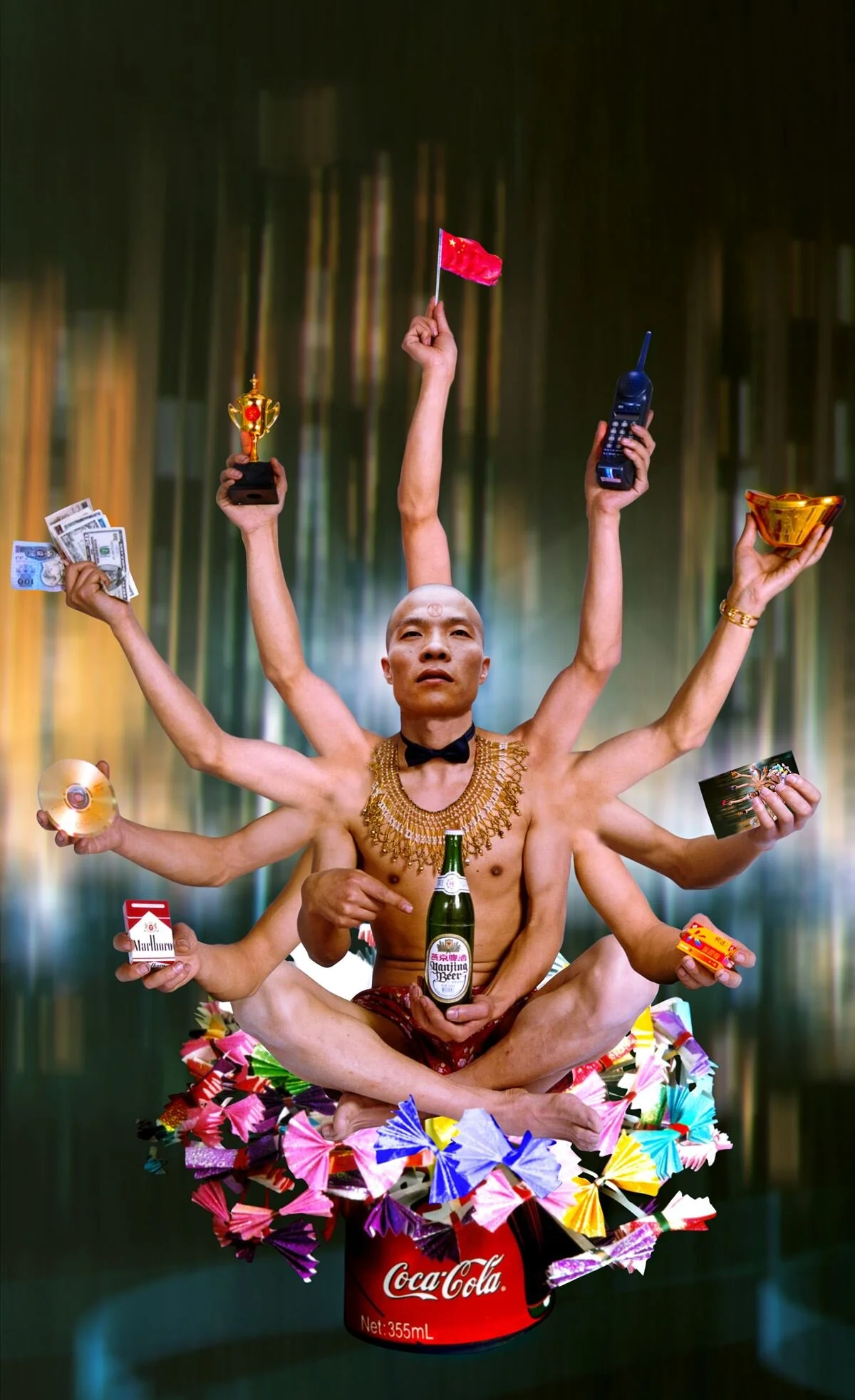
Wang Qingsong, Requesting Buddha Series No.1 (detail), 1999.
Members of the globalised consumer culture crave healing and enlightenment through consumption, and have lost touch with tradition and spirituality. Through this visual satire, Wang grapples with the hypocrisy of China’s obsession with consumption and loss of touch with tradition. Whilst globalisation has functioned to break down historical barriers between the East and the West, and thus expose Contemporary Chinese art internationally, it seems that Wang struggles to reconcile perceived benefits such as this, with inevitable consequences such as material obsession, and consumerism which plague China as a result. Jiangtao Gu suggests in ‘The monoculture of global capitalism and the state of contemporary Chinese art’ that ‘…a deconstruction of identities has not resulted in the disappearance of nation states. (Gu, 2016). There is a paradox of internationally influenced culture within a nation state such as China- this lies in the distance between the identity of the contemporary artist and their existence within the bounds of a nation state: ‘…isn’t the identity of “contemporary artist” already suggesting a subject position outside of the constricted borders of nation state?’ (Gu, 2016).
Wang’s photograph titled Follow Me depicts the photographer as subject, sitting behind a teacher’s desk, pointing at an exaggeratedly large blackboard, and is covered in messages relating to education and globalisation in China. Follow Me as a work discusses the aspirational mindset of many Chinese people since the onset of globalisation. The work points to contemporary Chinese society as increasing rapidly in terms of educational and economic prospect and competitiveness, influenced by the West. Globalisation has opened China to the international market, and the international market to China, and western influence has taken ahold of Chinese society. The ideals that many Chinese now aspire to are based on money, on rapid progress, on consumerism. These ideals differ greatly from those of traditional, nationalist China, rooted in the globalisation, notions of success, prosperity and fulfilment are changing.
Wang’s later work, Follow Him (2010), which would form a series with aforementioned Follow Me, again speaks to a particular aspiration and outlook toward education. The viewer is confronted with a large (130x300cm), heavily layered and colourful scene of chaos. Set in a studio, a scholar’s library room of bookshelves stacked messily floor to ceiling, the floor covered in pieces of scrunched up paper. The scholar, played by the artist in the photo, reads behind the desk. The photograph, like Follow Me suggests a critique upon China’s education system: that its students must study relentlessly, but to what end?
That success in education in the eyes of China is unattainable, no matter how hard the student tries, often the result is futile. The lighting of the photo is ominous and leads the eye back to more rows of bookshelves, more papers, more repetitive, futile symbols of a culture which urges its students to study more, and more, to wear themselves thin, even if the culmination of these efforts in a highly populated nationalist country, could potentially be nothing more than futility.
By means of photography, artists Muchen and Shao Yingong uncover and piece together unique Chinese histories lost in the Cultural Revolution. Their work acting as anthropological research project, as well as a means of catharsis for the artist and viewer. They work with memory, to uncover histories and to create a space between what has been lost and physically destructed and what can be found and reimagined, to re-envision China’s past, and their own memories.
Wang Qingsong harnesses photography as a tool for questioning and criticising Chinese society in the face of globalisation. The effects of globalisation are baffling to these contemporary Chinese artists, but also serve as impetus and enabling agent for the rise of contemporary Chinese art practice, particularly internationally.
Similar to the Cultural Revolution in that whilst this ongoing event constitutes another tragedy in Chinese history, it does work as a leverage of sorts for contemporary Chinese artists who deal with it in their lives and consequently in their work. Globalisation is a precursor to, and motivation for art work, through being an aspect of every Chinese individual’s life. Regardless of the individual’s opinion or reaction to it, globalisation is an essential facet of the rise and exposure of contemporary Chinese art. The function of the photographs of ….. and Wang Qingsong is to offer a means of expressing humanity, social reality, and feeling as opposed to functioning as propaganda, suggesting a departure from nationalist ideology (Shuxia, 2017).
Bibliography
Chen, Mu and Yinong, Shao, ‘It is Not Merely a Memory’ in Jiehong, J, 2007, Burden or Legacy: From the Chinese Cultural Revolution to Contemporary Art. Hong Kong University Press
Gladston, Paul, 2014 Contemporary Chinese Art : A Critical History. London: Reaktion Books.
Gu, Jiangtao 2016 ‘The Monoculture of Global Capitalism and the State of Contemporary Chinese art.(Essay).’ Journal of Contemporary Chinese Art 3, no. 3 (July 25 2019)
Jiehong, J. 2007 ‘Burden or legacy: From the Chinese cultural revolution to contemporary art’, in Burden or Legacy: From the Chinese Cultural Revolution to Contemporary Art. Hong Kong University Press.
Shuxia, Chen, 2017 ,’Departing from Socialist Realism: April Photo Society’ 1979-1981. Trans-Asia Photography Review. 8 (1)