
Wang Qingsong: capturing a kaleidoscopic society
2008Planning for his residency began earlier this year, when he spent a week acquainting himself with the area’s cultural landmarks and local people: “I cannot make my artworks simply emulations of real life,” he says “I need to make my own point. I like to stroll along the streets until I find a phenomenon that interests me.”
What fascinated him in this hitherto decimated industrial town was the positive effect the city’s extraordinary cultural redevelopment had had on its people. “I think artists, all really good artists can feel the genius loci and he’s certainly done so,” says Stella Hall, creative director of the initiative. “We’ve come through an economic time of great difficulty, and he sensed that.”
“I wanted to show the healing effect,” says Wang. “Most of my photographs are about this relationship between human beings and commercialism and I was so impressed with this experimental theatre – it’s covered with black wood inside, it’s really cool. And it made me think that both the theatre and the hospital are places where strangers sit, side by side, waiting to be healed.”
So began a search for 300 gowns, scrubs, tabards, stethoscopes. “Purchase of sterile hospital equipment by a theatre wasn’t the easiest thing to undertake,” Northern Stage’s artistic director Erica Whyman tells me “There are things in there that aren’t entirely hospital specific: some tequila party bags that might find their way onto stag nights, for example, are passing muster as IV drips.”
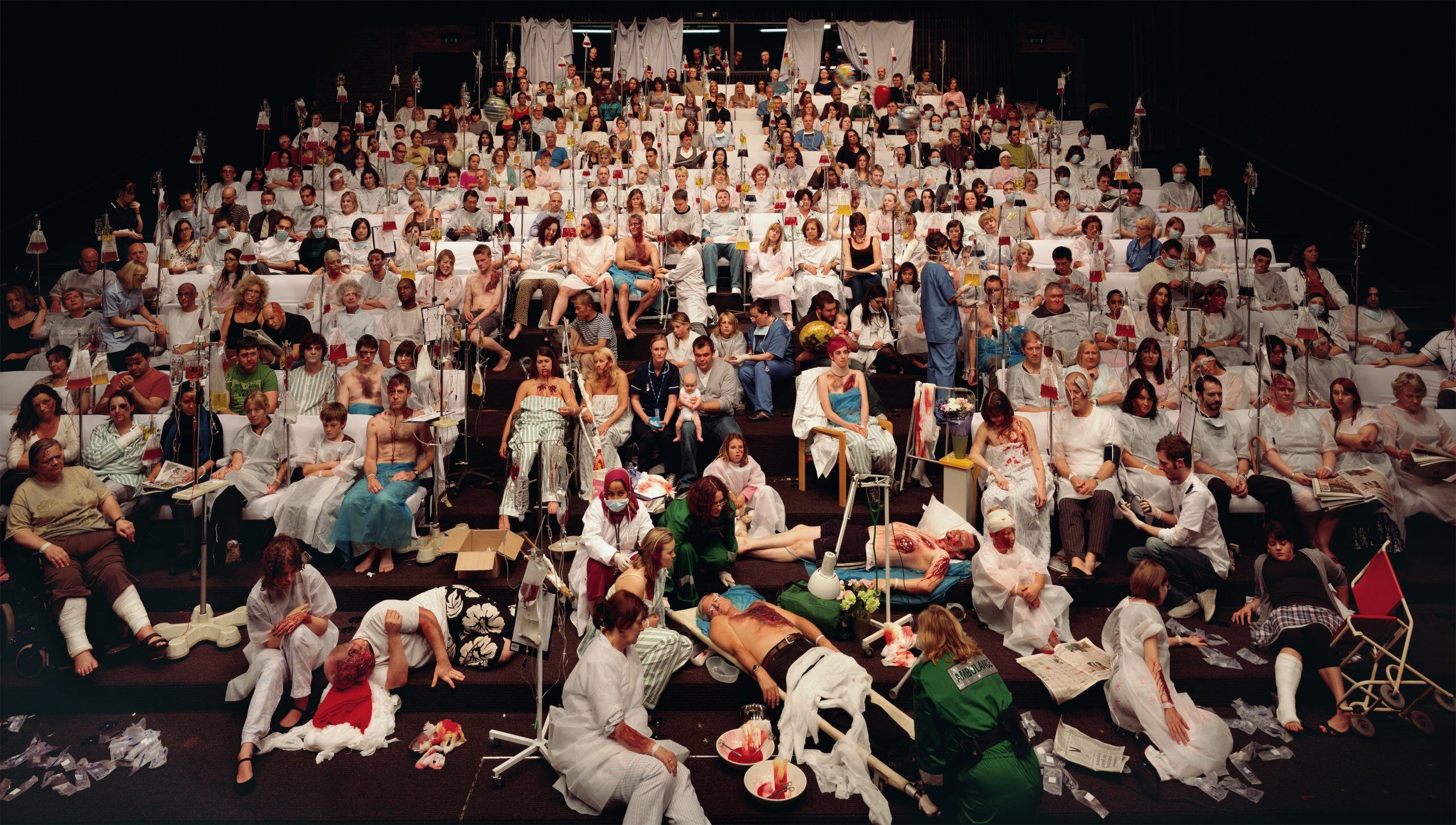
Temporary Ward, 180x320cm, light-box, 2008
The fruit of these labours is on show at BALTIC until the end of the month. Temporary Ward is a tableau three metres wide by nearly two metres tall, featuring 300 people dressed as hospital staff or patients, the latter festooned in latex wounds by local make-up artists. “Assigning 300 people different roles would have been tough,” Wang says “so I let them assume their own and then I selected the people I wanted for the centre of the picture, where my principal focus would be.”
Just to the left of this centre group sits Qingsong himself, hiding behind a newspaper. He often appears in his own photographs, acting as a form of narrator. “At first it was just more convenient to use myself, but now I think that I want to express that society is looking at me while I am looking at society.”
It is unsurprising that he picked up on Newcastle’s resurgence: furious commercial growth is something he has seen first hand. He emerged as an artist in the early nineties, when China was in the clutches of modernisation fever, its people reacting with both jubilation and confusion.
Rather than aiming fire at Western imperialism, it is China’s collusion in jettisoning its traditions that gets the full force of his blow. “It is like we have jumped from one to five,” he says, “without the numbers in between. The rise of consumerism in the West moved at a slower pace which has been less threatening to its culture. After the turbulence of the past few decades, the ancient traditions of China are gone. Mindless pride in our nation has been replaced by a mindless desire for Western consumption.”
Wang’s large-scale photographs wrestle with the knotty contradictions of his homeland China. Vibrant, glossy, with a flatness reminiscent of traditional scrolls, his tableau-style photographs look to his immediate environment for inspiration. American logos, especially McDonald’s and Coca-Cola, figure prominently. Kitschy yet heavily conceptual, they are designed to transmit clear, usually political messages.
He was born in a small town in the province of Heilongjiang in 1966, the year China began to convulse to the tune of Mao’s disastrous Cultural Revolution. His father died when he was 15 and Wang became his family’s breadwinner, working on the oil fields. He applied five times to various art academies before being accepted at Sichuan, graduating in 1991.
“Contemporary art from abroad was only just starting to make its way into the schools” he recalls “And back then art schools didn’t teach photography at all.” Afterwards he moved to Beijing, where he became part of Yuan Ming Yuan, the artist’s colony that was later forcefully closed by the authorities.
Originally a painter, he moved into photography fairly early in his career, finding that what he wanted to say in his work could not be expressed with a paint brush. “The social changes were so drastic; I began to feel out of the tune with the times. In such a kaleidoscopic society, I needed the immediacy of the camera to narrate my stories about China.”